Accuracy and Precision in Measurement
Understand the difference between accuracy and precision in scientific measurements, analyze data, and identify factors affecting measurement quality.
Includes
Standards
Topics
Accuracy and Precision in Measurement
Name:
Date:
Score:
Read each question carefully and provide thoughtful answers. Use the provided space for your responses.
In scientific measurements, 'accuracy' and 'precision' are two critical concepts that describe the quality of data. While often used interchangeably in everyday language, they have distinct meanings in a scientific context. Understanding the difference is fundamental to conducting reliable experiments and interpreting results.
1. Which term describes how close a measurement is to the true or accepted value?
Precision
Accuracy
Reliability
Validity
2. A student repeatedly measures the mass of a known 10.0 g weight. Their measurements are 9.9 g, 10.1 g, 10.0 g, and 9.9 g. These measurements can be described as:
Accurate and precise
Accurate but not precise
Precise but not accurate
Neither accurate nor precise
3. Random errors primarily affect the of a measurement, while systematic errors primarily affect the of a measurement.
4. A measuring instrument that consistently gives readings that are too high has a error.
5. It is possible for a set of measurements to be precise but not accurate.
True
False
6. Improving the precision of a measurement automatically improves its accuracy.
True
False
7. A dart player consistently hits the same spot on a dartboard, but that spot is far from the bullseye. Describe the player's accuracy and precision.
8. Explain how a systematic error differs from a random error in an experiment.
9. Analyze the following target diagrams. For each diagram, determine if the shots are accurate, precise, both, or neither.

Diagram A:
Explanation:
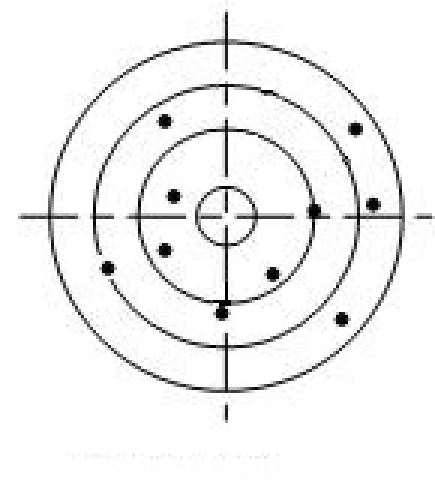
Diagram B:
Explanation: