Understanding Taxation
A Grade 11 Social Studies worksheet exploring the fundamentals of taxation, its types, principles, and impact on society and the economy.
Includes
Standards
Topics
Understanding Taxation
Name:
Date:
Score:
Read each question carefully and provide thoughtful answers. This worksheet covers key concepts related to taxation, its types, and its role in society.
1. Which of the following is NOT a primary purpose of taxation?
Funding public services
Redistributing income and wealth
Discouraging certain behaviors
Maximizing corporate profits
2. A tax system where the tax rate increases as the taxable amount increases is known as a:
Regressive tax
Proportional tax
Progressive tax
Flat tax
3. The principle of taxation that states individuals should pay taxes based on their ability to pay is called the principle.
4. A tax levied on goods and services at the point of sale is known as a tax.
5. Excise taxes are typically imposed on necessities.
True
False
6. Fiscal policy primarily involves government spending and taxation to influence the economy.
True
False
7. Explain the difference between direct and indirect taxes, providing an example of each.
8. Discuss how taxation can be used as a tool for income redistribution.
Examine the image below, titled 'Paying the Tax (The Tax Collector)' by Pieter Brueghel the Younger. This painting depicts a historical scene related to taxation.
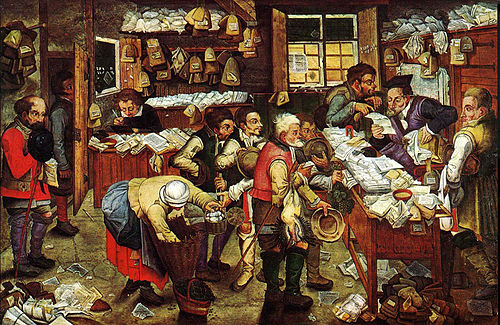
9. Based on your observation of the painting, what can you infer about the nature of taxation and its impact on ordinary people during the period depicted (17th century)? Consider the expressions of the people and the overall setting.