Understanding Globalization
This worksheet explores the concept of globalization, its various dimensions, impacts, and challenges at a Grade 11 level, aligning with world history and social studies curricula.
Includes
Standards
Topics
Understanding Globalization
Name:
Date:
Score:
Read each question carefully and answer to the best of your ability. For multiple-choice questions, circle the correct option. For short answer and essay questions, provide detailed responses.
1. Which of the following best defines globalization?
The process of national isolation and protectionism.
The increasing interconnectedness and interdependence of countries and people worldwide.
The decline of international trade and communication.
The establishment of a single global government.
2. Which technological advancement has most significantly contributed to the acceleration of globalization?
The invention of the printing press.
The development of steam engines.
The rise of the internet and digital communication.
The discovery of electricity.
1. The is an organization that deals with the rules of trade between nations.
2. refers to the spread of cultural ideas, values, and practices around the world.
3. The concept of a 'global village' was popularized by Marshall McLuhan to describe the effects of mass media on and .
1. Globalization primarily affects economic aspects of society, with minimal impact on culture.
True
False
2. The rise of multinational corporations is a significant driver of economic globalization.
True
False
1. Identify and briefly explain two positive impacts of globalization on developing countries.
2. What is cultural homogenization, and how is it related to globalization?
Observe the world map below.
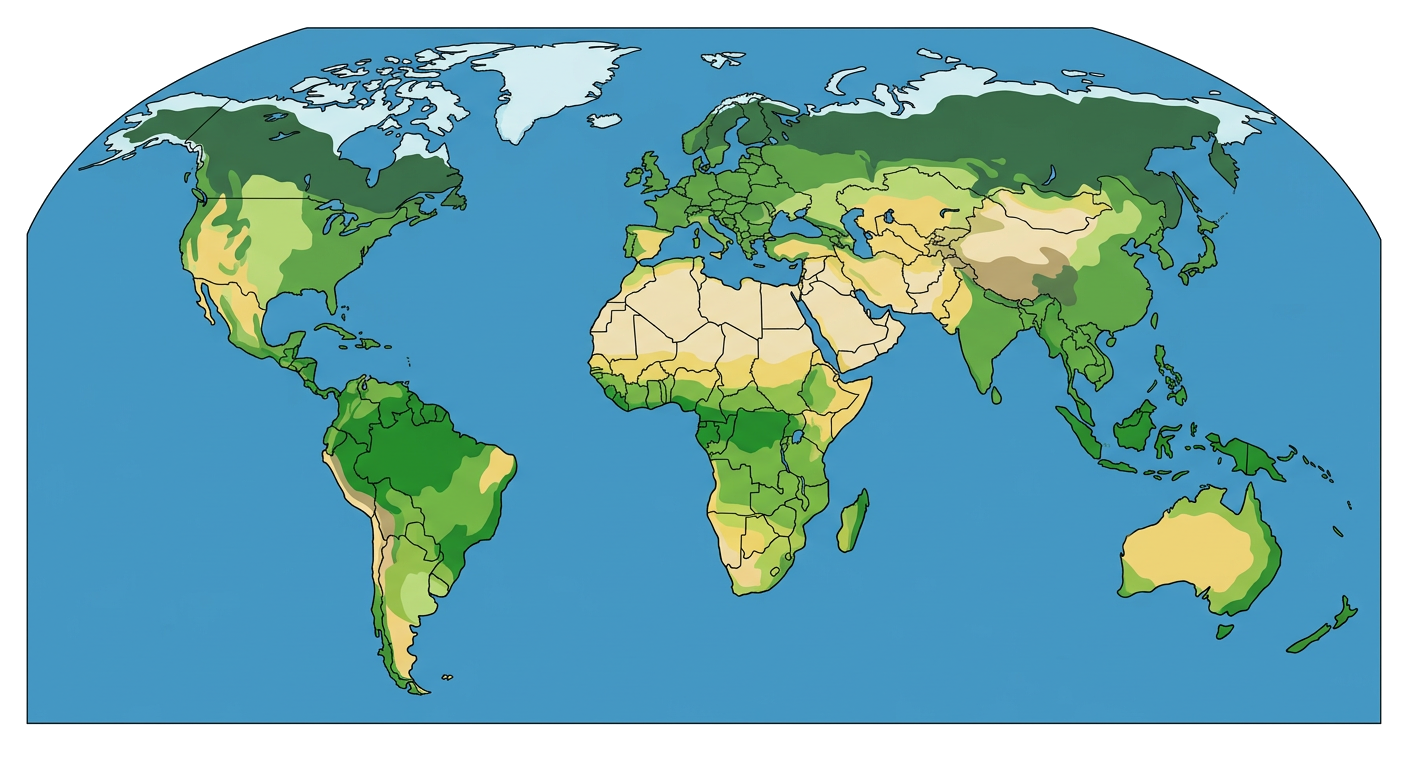
3. Using the map as a reference, discuss how geographical proximity and transportation routes contribute to patterns of global trade.
Use the words below to complete the sentences.
1. Many companies engage in to reduce labor costs by moving production to other countries.
2. The increasing among nations means that economic downturns in one country can affect others globally.
3. The policy of aims to protect domestic industries from foreign competition through tariffs and quotas.