Orienteering Skills Worksheet
A Grade 12 Physical Education worksheet covering orienteering principles, map reading, compass use, and safety for outdoor and adventure activities.
Includes
Topics
Orienteering Skills Assessment
Name:
Date:
Score:
Read each question carefully and answer to the best of your ability. This worksheet assesses your understanding of advanced orienteering concepts and techniques.
1. Which of the following is NOT a primary purpose of using 'attack points' in advanced orienteering?
To provide a clear, identifiable feature near the control.
To enable precise navigation to the control point.
To avoid difficult terrain on the final approach.
To practice compass bearings over long distances.
2. When 'thumbing the map,' what is the primary benefit for an orienteer?
It allows for quick adjustment of the compass declination.
It keeps track of the current position on the map without losing focus.
It helps in folding the map to fit into a map holder.
It signals to other competitors that you are in the lead.
3. The difference between true north and magnetic north is known as magnetic .
4. A line is an imaginary line on a map connecting points of equal elevation.
5. In orienteering, is the technique of selecting a prominent distant object and walking towards it on a bearing.
6. Contour intervals are typically consistent across an entire orienteering map.
True
False
7. Catching features are used to prevent overshooting a control point.
True
False
8. Explain the concept of 'relocation' in orienteering and when it is necessary.
9. Describe at least three different map symbols commonly found on an orienteering map and what they represent.
Match each orienteering term with its correct definition.
10. Bearing
a. A linear feature that guides an orienteer, such as a fence or river.
11. Handrail
b. The direction of travel, measured in degrees from North.
12. Col
c. A saddle or pass between two peaks or hills.
13. Dogleg
d. A control point that is deliberately placed off a direct line for strategic reasons.
14. Using the provided compass illustration, identify the following parts:
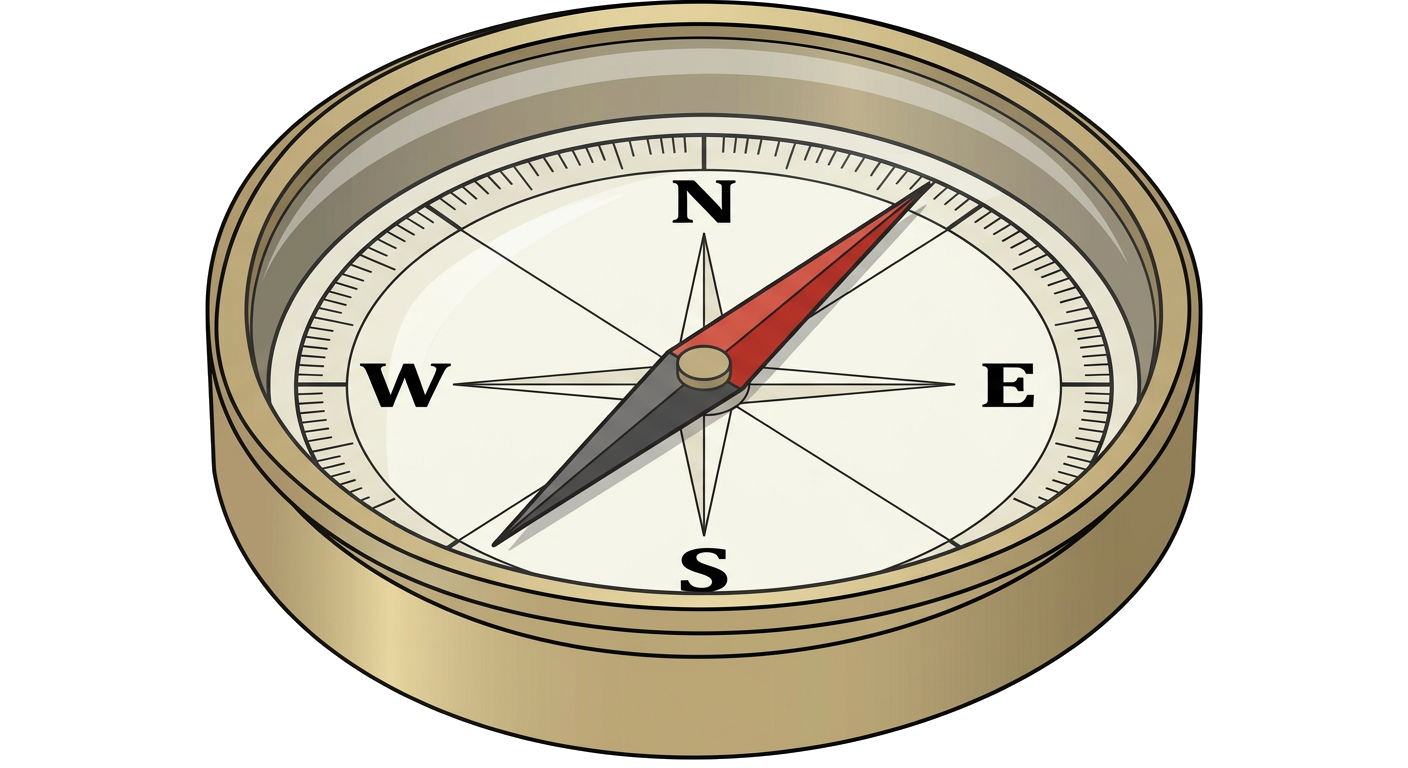
a. Direction of Travel Arrow:
b. Magnetic Needle:
c. Orienting Arrow (Red Shed):
d. Baseplate: