Grade 12 Chemistry: Ionic Bonding
Explore the principles of ionic bonding, including electron transfer, electrostatic attraction, and properties of ionic compounds, suitable for Grade 12 chemistry students.
Includes
Standards
Grade 12 Chemistry: Ionic Bonding
Name:
Date:
Score:
Read each question carefully and provide your best answer. Show all your work for calculations.
1. Which of the following best describes an ionic bond?
Sharing of electrons between two nonmetals.
Transfer of electrons from a metal to a nonmetal.
Attraction between two oppositely charged ions in solution.
Formation of a sea of delocalized electrons.
2. Which pair of elements is most likely to form an ionic bond?
Carbon and Oxygen
Nitrogen and Hydrogen
Sodium and Chlorine
Sulfur and Oxygen
3. Ionic bonds are formed between a and a , resulting in the of electrons.
4. The strong electrostatic attraction between oppositely charged ions forms a crystal .
5. Ionic compounds typically have low melting and boiling points.
True
False
6. Ionic compounds conduct electricity when dissolved in water or in their molten state.
True
False
7. Explain why metals tend to lose electrons and nonmetals tend to gain electrons when forming ionic bonds.
8. Draw a Lewis dot structure to illustrate the formation of an ionic bond between Magnesium and Oxygen.
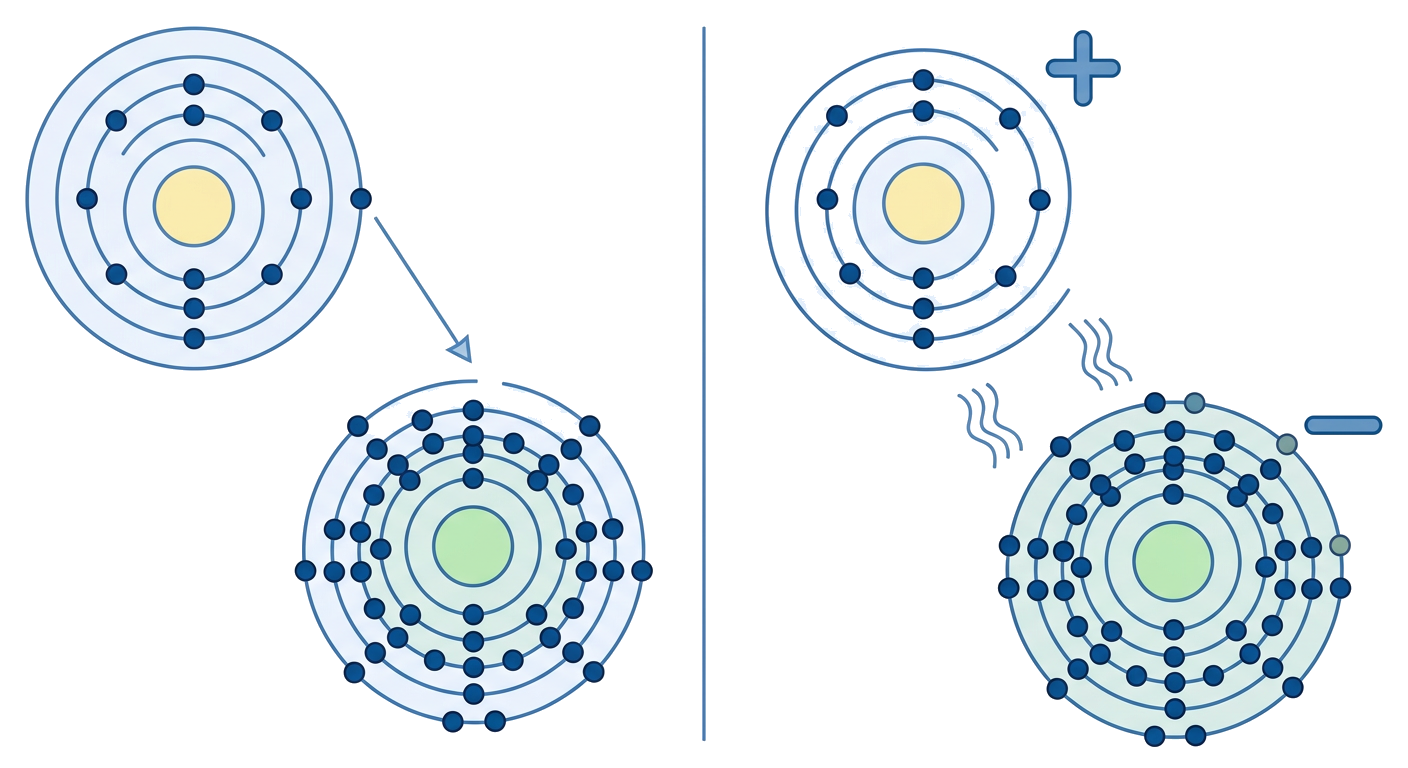
Match the term to its definition.
9. Cation
a. An ion with a negative charge
10. Anion
b. An ion with a positive charge
11. Electronegativity
c. The ability of an atom to attract electrons in a chemical bond
Related Worksheets
Physical and Chemical Properties and Changes
Explore the fundamental concepts of physical and chemical properties and changes through various exercises for Grade 12 Chemistry.
Grade 12 Chemistry: Types of Reactions
A worksheet covering various types of chemical reactions for Grade 12 Chemistry students, including synthesis, decomposition, single displacement, double displacement, combustion, and redox reactions.