Binary Ionic Compounds Worksheet
A Grade 12 Chemistry worksheet focusing on the nomenclature, properties, and formation of binary ionic compounds.
Includes
Standards
Topics
Binary Ionic Compounds
Name:
Date:
Score:
Read each question carefully and provide your best answer. Show all work for calculations.
1. Which of the following elements would most likely form a binary ionic compound with bromine?
Carbon
Sodium
Oxygen
Neon
2. What is the correct name for the compound MgCl₂?
Magnesium dichloride
Magnesium chloride
Magnesium(II) chloride
Manganese chloride
1. In a binary ionic compound, the total positive charge must be equal to the total charge.
2. Binary ionic compounds are formed between a and a .
3. When naming a binary ionic compound, the anion always ends with the suffix .
1. Write the chemical formula for potassium iodide.
2. Name the binary ionic compound with the formula Li₂O.
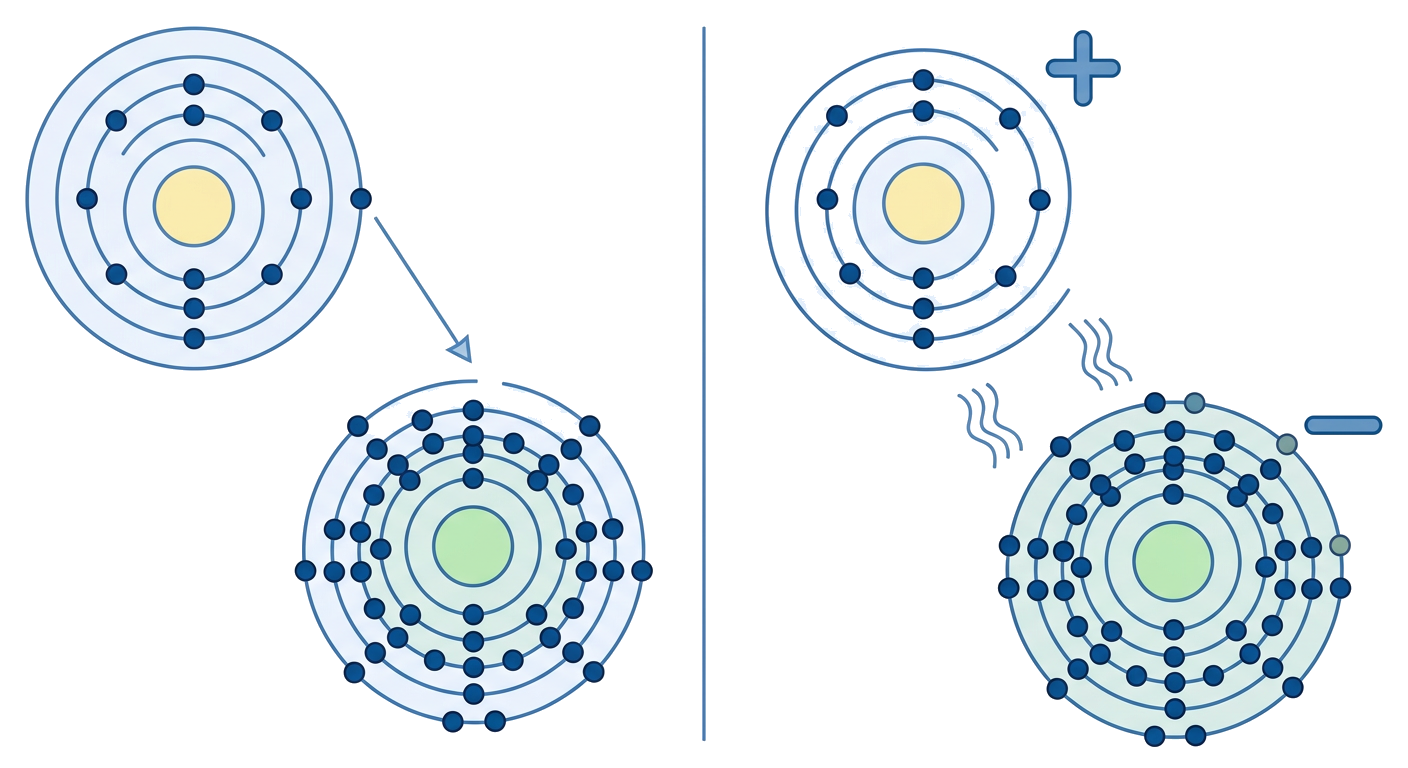
Observe the illustration below showing the formation of an ionic bond. Pay attention to the transfer of electrons.
1. All binary ionic compounds are composed of exactly two different elements.
True
False
2. Transition metals always have only one possible charge in ionic compounds.
True
False
Match the ionic compound formula with its correct name.
1. Al₂O₃
a. Iron(II) chloride
2. FeO
b. Aluminum oxide
3. CaCl₂
c. Calcium chloride
Explain why ionic compounds typically have high melting points and are good conductors of electricity when molten or dissolved in water, but not when solid.
Related Worksheets
Physical and Chemical Properties and Changes
Explore the fundamental concepts of physical and chemical properties and changes through various exercises for Grade 12 Chemistry.
Grade 12 Chemistry: Types of Reactions
A worksheet covering various types of chemical reactions for Grade 12 Chemistry students, including synthesis, decomposition, single displacement, double displacement, combustion, and redox reactions.