Calorimetry Principles and Applications
A Grade 12 Chemistry worksheet exploring the principles, types, and applications of calorimetry, including calculations and experimental design.
Includes
Standards
Calorimetry Principles and Applications
Name:
Date:
Score:
Read each question carefully and provide thorough answers. Show all calculations where applicable.
1. Which of the following best describes the primary function of a calorimeter?
To measure the rate of a chemical reaction.
To determine the heat capacity of a substance.
To measure the change in enthalpy of a chemical or physical process.
To analyze the elemental composition of a sample.
2. In a bomb calorimeter, why is the reaction vessel sealed and immersed in a known quantity of water?
To prevent evaporation of the sample.
To ensure the reaction occurs at constant pressure.
To measure the heat transferred to or from the surroundings.
To maintain a constant volume for the reaction.
3. A calorimeter is an apparatus used to measure the amount of evolved or absorbed during a chemical or physical change.
4. The specific heat capacity of a substance is the amount of required to raise the temperature of one gram of the substance by one degree Celsius.
5. Describe the key differences between a bomb calorimeter and a coffee-cup calorimeter, highlighting their respective applications and limitations.
6. Observe the diagram of a typical coffee-cup calorimeter below. Identify the labeled components and explain the function of each in the calorimetry experiment.
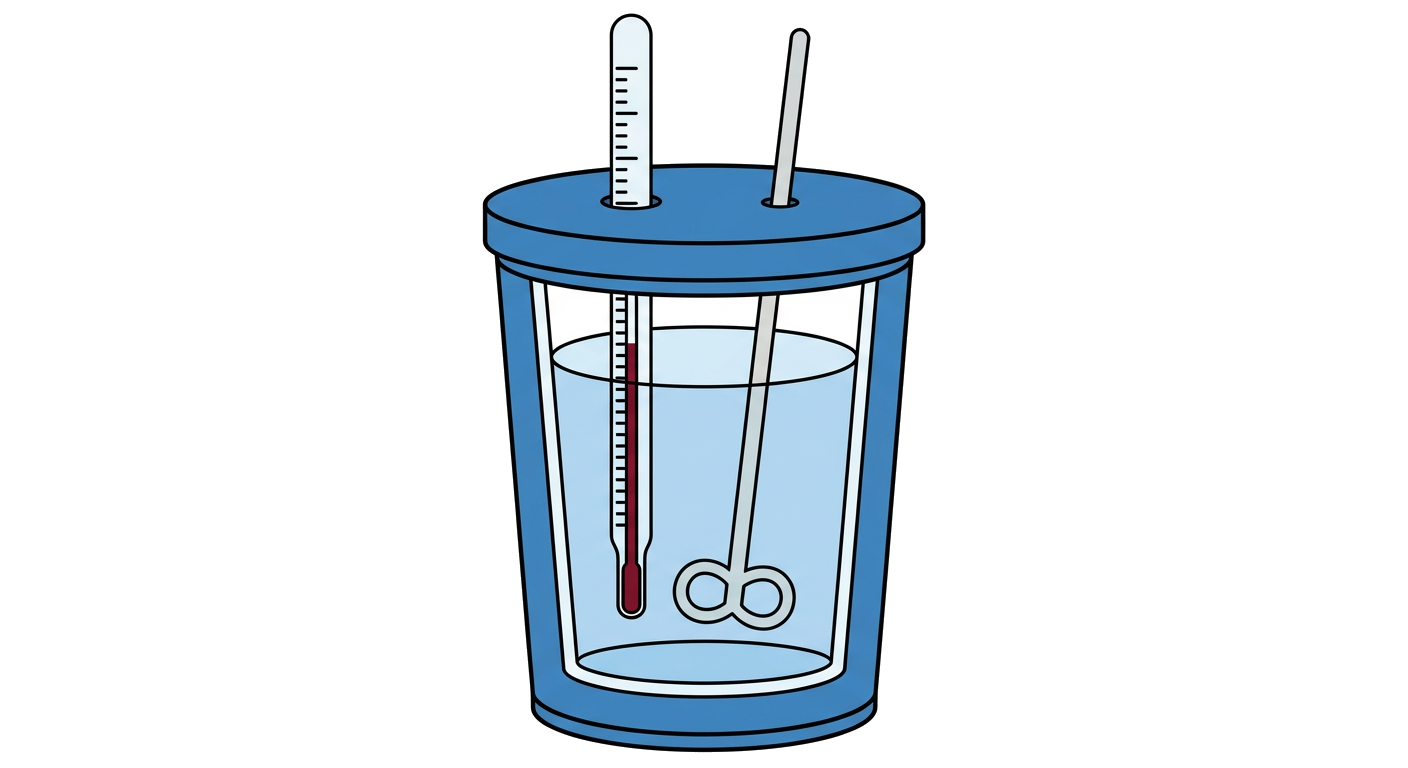
A:
B:
C:
D:
7. A 5.00 g sample of an unknown metal at 90.0 °C is placed into a coffee-cup calorimeter containing 50.0 g of water at 22.0 °C. The final temperature of the water and metal is 25.3 °C. Assuming no heat loss to the surroundings and the specific heat capacity of water is 4.18 J/g°C, calculate the specific heat capacity of the unknown metal.
8. A perfect calorimeter would completely prevent any heat exchange with the surroundings.
True
False
Related Worksheets
Physical and Chemical Properties and Changes
Explore the fundamental concepts of physical and chemical properties and changes through various exercises for Grade 12 Chemistry.
Grade 12 Chemistry: Types of Reactions
A worksheet covering various types of chemical reactions for Grade 12 Chemistry students, including synthesis, decomposition, single displacement, double displacement, combustion, and redox reactions.