Chemical Bonding Worksheet
Grade 12 Chemistry worksheet covering ionic, covalent, and metallic bonding, intermolecular forces, and their impact on properties.
Includes
Standards
Chemical Bonding
Name:
Date:
Score:
Read each question carefully and answer to the best of your ability. Show all your work for calculations.
1. Which type of bond involves the electrostatic attraction between oppositely charged ions?
Covalent bond
Ionic bond
Metallic bond
Hydrogen bond
2. Which of the following statements correctly describes a polar covalent bond?
Electrons are shared equally between two atoms.
Electrons are transferred from one atom to another.
Electrons are shared unequally between two atoms.
It forms between a metal and a nonmetal.
1. The ability of an atom to attract electrons in a chemical bond is called .
2. In a metallic bond, valence electrons are delocalized and form a 'sea of electrons' around the positively charged .
3. Van der Waals forces are a type of intermolecular force.
1. Explain the difference between an ionic bond and a covalent bond, providing an example for each.
2. Describe how hydrogen bonding influences the unique properties of water.
1. All polar molecules have dipole-dipole interactions.
True
False
2. The stronger the intermolecular forces, the lower the boiling point of a substance.
True
False
Observe the diagram below and answer the question.
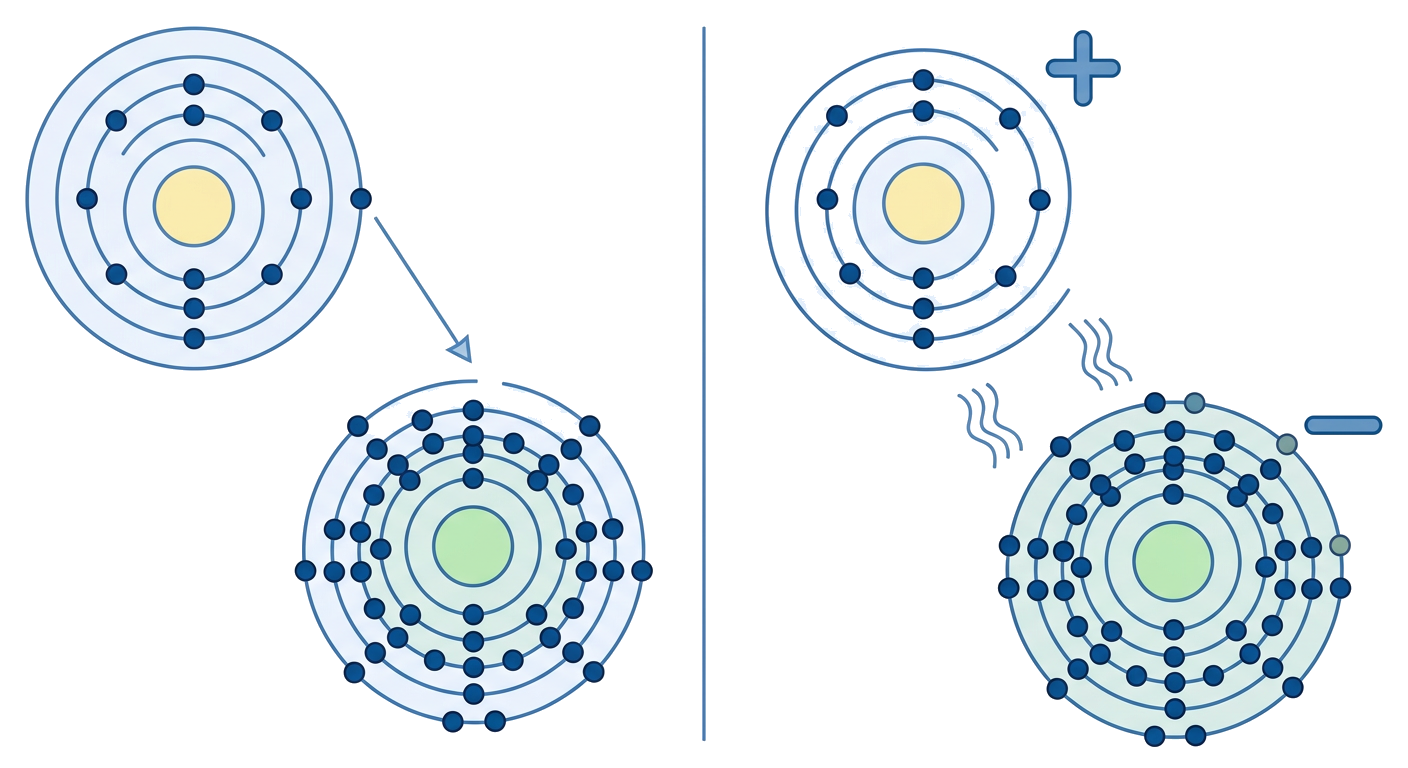
Based on the diagram, describe the process of ionic bond formation between a sodium atom and a chlorine atom.
Match each term on the left with its definition on the right.
1. Electronegativity
a. Forces between molecules
2. Octet rule
b. Tendency of an atom to attract electrons in a bond
3. Intermolecular forces
c. Atoms tend to gain, lose, or share electrons to achieve 8 valence electrons
Discuss the different types of intermolecular forces (London Dispersion Forces, Dipole-Dipole Interactions, and Hydrogen Bonding). Provide examples of molecules that exhibit each type and explain how these forces affect the physical properties (e.g., boiling point, solubility) of substances.
Related Worksheets
Physical and Chemical Properties and Changes
Explore the fundamental concepts of physical and chemical properties and changes through various exercises for Grade 12 Chemistry.
Grade 12 Chemistry: Types of Reactions
A worksheet covering various types of chemical reactions for Grade 12 Chemistry students, including synthesis, decomposition, single displacement, double displacement, combustion, and redox reactions.