Colligative Properties Worksheet
Explore colligative properties including vapor pressure lowering, boiling point elevation, freezing point depression, and osmotic pressure with this Grade 12 chemistry worksheet.
Includes
Standards
Colligative Properties
Name:
Date:
Score:
Read each question carefully and answer to the best of your ability. Show all work for calculations.
1. Which of the following is NOT considered a colligative property?
Vapor pressure lowering
Boiling point elevation
Surface tension
Osmotic pressure
2. Adding a non-volatile solute to a solvent will:
Increase its freezing point
Decrease its boiling point
Lower its vapor pressure
Increase its volatility
3. Colligative properties depend only on the of solute particles in a solution, not on their identity.
4. The phenomenon where the freezing point of a solvent is lowered by the addition of a solute is called .
5. The pressure required to stop osmosis across a semipermeable membrane is known as .
6. Explain why adding salt to water makes it boil at a higher temperature and freeze at a lower temperature.
7. Describe the process of osmosis and its importance in biological systems.
Observe the image below, which illustrates different types of mixtures. A solution is a homogeneous mixture where one substance dissolves in another, typically maintaining a uniform composition.
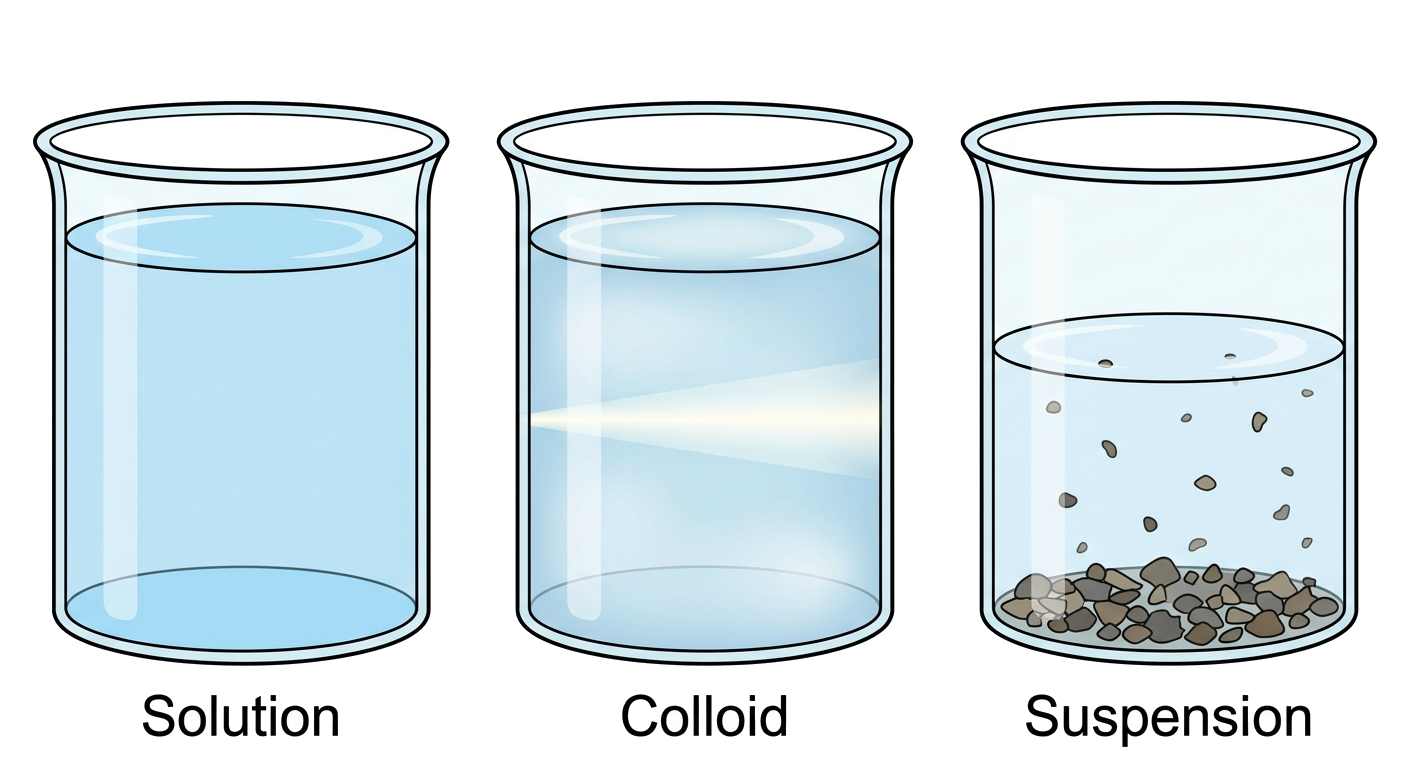
8. Based on your understanding of colligative properties, why are these properties most evident in true solutions rather than suspensions or colloids?
9. A solution with a higher concentration of solute particles will always have a lower osmotic pressure.
True
False
10. The van 't Hoff factor (i) accounts for the dissociation of ionic compounds in solution when calculating colligative properties.
True
False
Related Worksheets
Physical and Chemical Properties and Changes
Explore the fundamental concepts of physical and chemical properties and changes through various exercises for Grade 12 Chemistry.
Grade 12 Chemistry: Types of Reactions
A worksheet covering various types of chemical reactions for Grade 12 Chemistry students, including synthesis, decomposition, single displacement, double displacement, combustion, and redox reactions.