Conservation of Mass Worksheet
A Grade 12 science worksheet focusing on the Law of Conservation of Mass, including balancing chemical equations and calculating reactant/product masses.
Includes
Standards
Topics
Conservation of Mass: Grade 12 Chemistry
Name:
Date:
Score:
Read each question carefully and answer to the best of your ability. Show all your work for calculations.
1. Which of the following statements best describes the Law of Conservation of Mass?
Mass can be created or destroyed in a chemical reaction.
The total mass of reactants is always less than the total mass of products.
In a closed system, the total mass of the reactants equals the total mass of the products.
Energy is conserved, but mass is not.
2. The Law of Conservation of Mass was first formulated by Antoine Lavoisier in the year .
3. In a chemical reaction, atoms are rearranged but not or .
4. Balancing chemical equations ensures that the number of atoms of each element is on both sides of the reaction.
5. Balance the following chemical equation:
Fe₂O₃(s) + CO(g) → Fe(s) + CO₂(g)
6. Balance the following chemical equation:
C₃H₈(g) + O₂(g) → CO₂(g) + H₂O(g)
7. If 10 grams of reactant A reacts completely with 5 grams of reactant B, the products must have a combined mass of 15 grams.
True
False
8. In an experiment, 24.3 g of magnesium reacts with oxygen to form 40.3 g of magnesium oxide. According to the Law of Conservation of Mass, how much oxygen reacted?
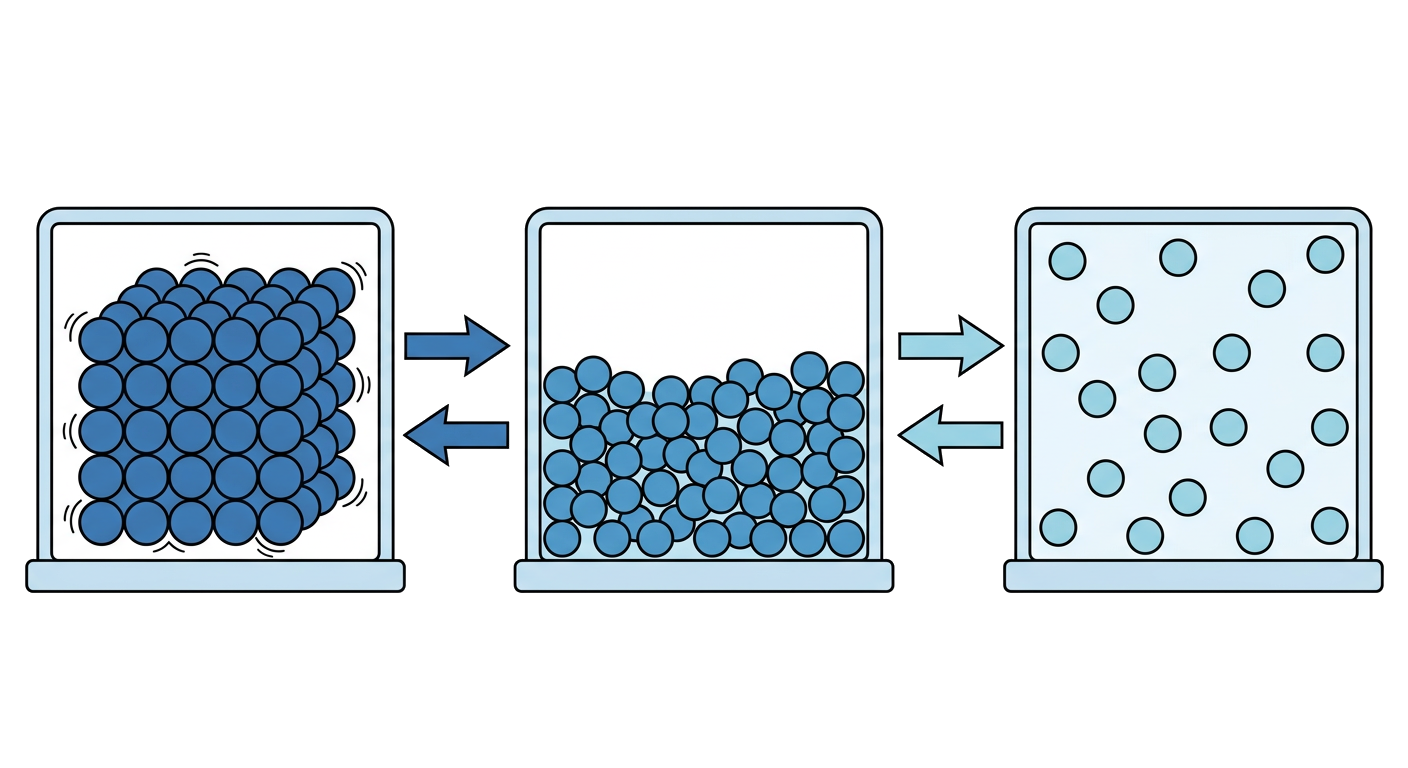
9. Consider the following diagram representing a chemical reaction. Explain how this diagram illustrates the Law of Conservation of Mass.
Related Worksheets
Physical and Chemical Properties and Changes
Explore the fundamental concepts of physical and chemical properties and changes through various exercises for Grade 12 Chemistry.
Grade 12 Chemistry: Types of Reactions
A worksheet covering various types of chemical reactions for Grade 12 Chemistry students, including synthesis, decomposition, single displacement, double displacement, combustion, and redox reactions.