Covalent Bonding Worksheet
Grade 12 Chemistry worksheet focusing on understanding and identifying covalent bonds, including molecular geometry and polarity.
Includes
Standards
Topics
Covalent Bonding Worksheet
Name:
Date:
Score:
Read each question carefully and provide detailed answers or select the best option. Show all your work for calculations.
1. What is a covalent bond? Describe the primary mechanism by which a covalent bond forms between two atoms.
2. Which of the following best describes a nonpolar covalent bond?
Electrons are transferred from one atom to another.
Electrons are shared unequally between two atoms.
Electrons are shared equally between two atoms.
Atoms lose or gain electrons to form ions.
3. Consider the illustration below. What type of covalent bond is depicted?
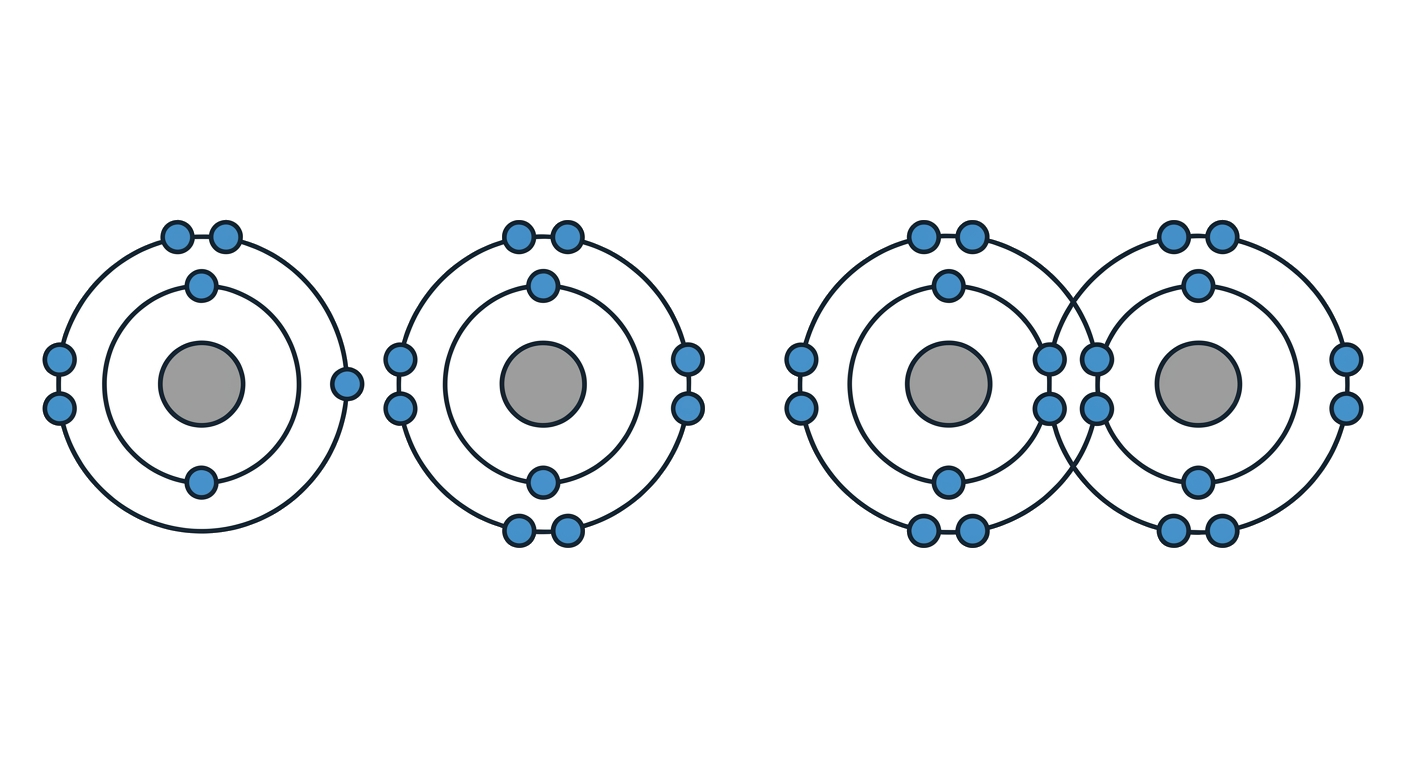
Single covalent bond
Double covalent bond
Triple covalent bond
Ionic bond
4. The VSEPR theory helps predict the of molecules based on the repulsion between electron pairs.
5. A molecule with polar bonds can be nonpolar overall if its molecular geometry results in a distribution of electron density.
6. Draw the Lewis structure for the water molecule (H2O). Indicate any lone pairs and predict its molecular geometry and polarity. Explain your reasoning.
7. All molecules with polar covalent bonds are polar molecules.
True
False
Related Worksheets
Physical and Chemical Properties and Changes
Explore the fundamental concepts of physical and chemical properties and changes through various exercises for Grade 12 Chemistry.
Grade 12 Chemistry: Types of Reactions
A worksheet covering various types of chemical reactions for Grade 12 Chemistry students, including synthesis, decomposition, single displacement, double displacement, combustion, and redox reactions.