Covalent Compounds Worksheet
A Grade 12 Chemistry worksheet focusing on covalent compounds, their properties, bonding, and nomenclature.
Includes
Standards
Topics
Covalent Compounds: Grade 12 Chemistry
Name:
Date:
Score:
Read each question carefully and provide concise, accurate answers. Show all your work for calculations.
1. Which of the following best describes a covalent bond?
Transfer of electrons between atoms
Sharing of electrons between atoms
Attraction between oppositely charged ions
Formation of a sea of delocalized electrons
2. Which of the following compounds contains only covalent bonds?
NaCl
H2O
KF
MgO
3. In a nonpolar covalent bond, electrons are shared between two atoms.
4. The ability of an atom to attract electrons in a chemical bond is called .
5. Explain the difference between a polar and a nonpolar covalent bond. Provide an example for each.
6. Covalent compounds generally have high melting and boiling points.
True
False
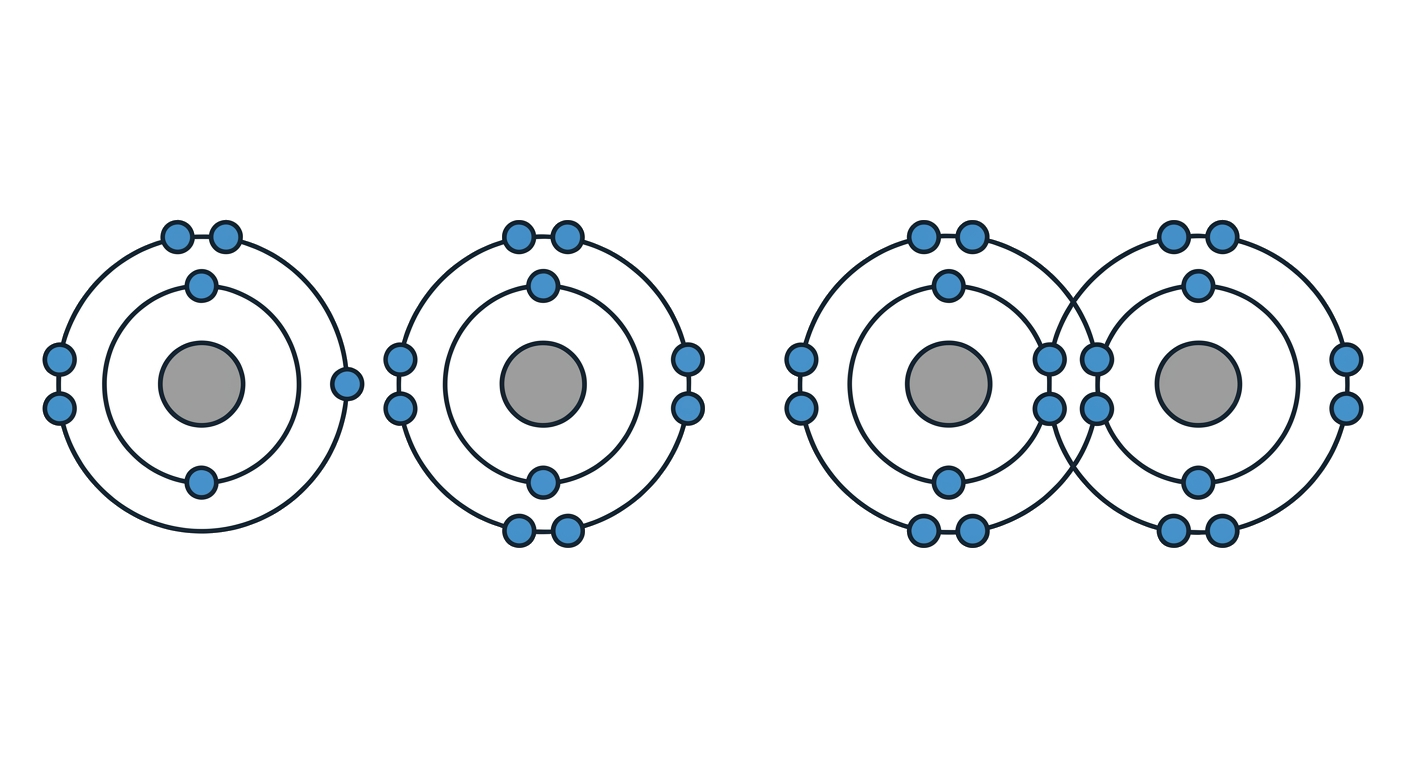
7. The illustration below shows the formation of a covalent bond.
True
False
Match the term on the left with its definition on the right.
8. Single bond
a. Two pairs of shared electrons
9. Double bond
b. One pair of shared electrons
10. Triple bond
c. Three pairs of shared electrons
11. Write the chemical formula for dinitrogen tetroxide.
12. Name the compound with the formula PCl3.
Related Worksheets
Physical and Chemical Properties and Changes
Explore the fundamental concepts of physical and chemical properties and changes through various exercises for Grade 12 Chemistry.
Grade 12 Chemistry: Types of Reactions
A worksheet covering various types of chemical reactions for Grade 12 Chemistry students, including synthesis, decomposition, single displacement, double displacement, combustion, and redox reactions.