Interpreting Spectra Worksheet
A Grade 12 Science worksheet focused on interpreting various types of spectra, including emission, absorption, and mass spectra.
Includes
Standards
Interpreting Spectra
Name:
Date:
Score:
Read each question carefully and provide your best answer. Use the provided diagrams and information to interpret the spectra.
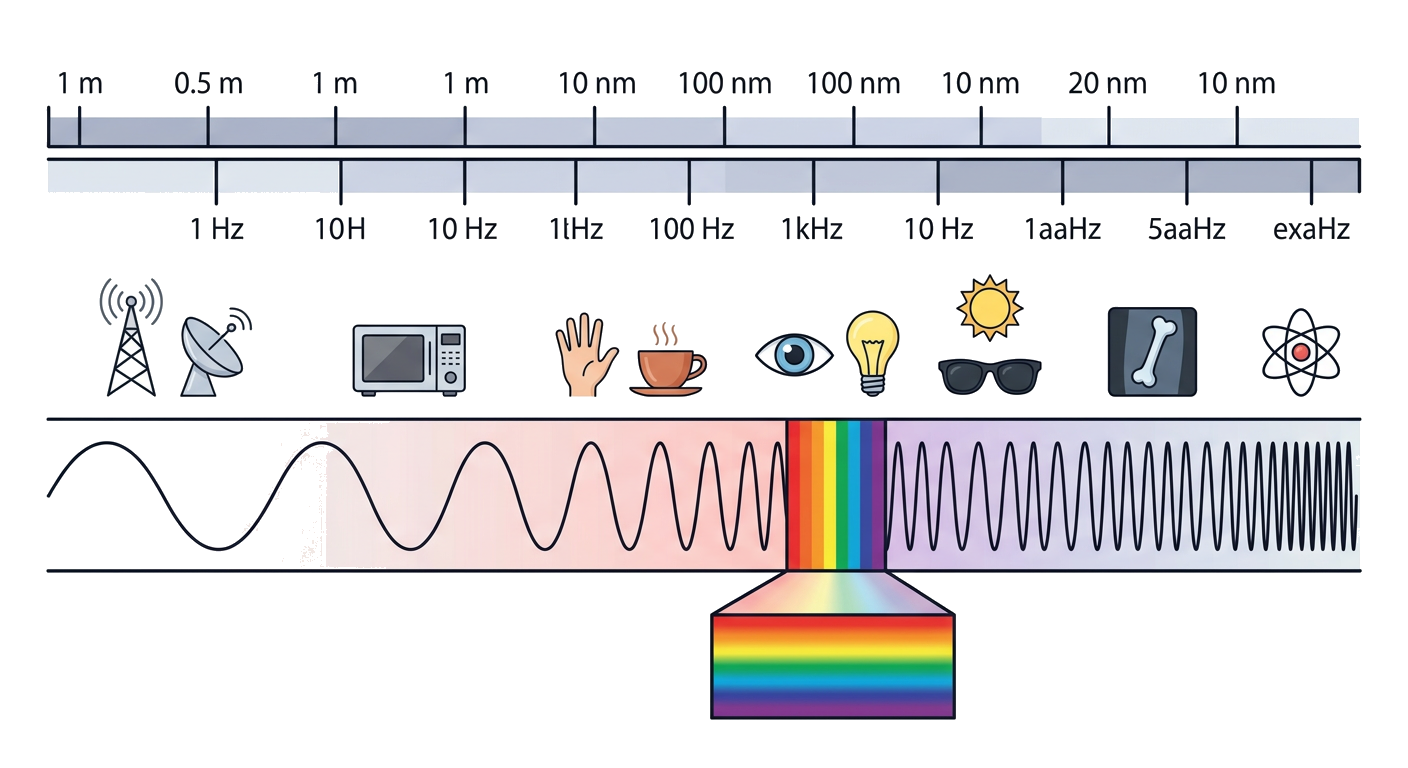
1. Observe the electromagnetic spectrum below. Which type of radiation has the longest wavelength and lowest frequency?
2. An absorption spectrum is created when:
Electrons in a gas jump to higher energy levels and emit photons.
Light passes through a cool gas, and specific wavelengths are absorbed.
A continuous spectrum of light is produced by a hot, dense object.
Molecules vibrate and rotate, absorbing energy in the infrared region.
3. In mass spectrometry, the molecular ion peak represents the of the molecule.
4. Fragmentation patterns in a mass spectrum can help identify the structure of a compound.
5. Explain how an emission spectrum can be used to identify unknown elements in a sample. What principle is this based on?
6. True or False: Infrared (IR) spectroscopy is primarily used to identify functional groups in organic molecules.
True
False
Match each spectroscopy technique with its primary application.
7. UV-Vis Spectroscopy
a. Elemental composition
8. Atomic Emission Spectroscopy
b. Conjugated systems and concentrations
9. NMR Spectroscopy
c. Structural elucidation of organic molecules
Related Worksheets
Physical and Chemical Properties and Changes
Explore the fundamental concepts of physical and chemical properties and changes through various exercises for Grade 12 Chemistry.
Grade 12 Chemistry: Types of Reactions
A worksheet covering various types of chemical reactions for Grade 12 Chemistry students, including synthesis, decomposition, single displacement, double displacement, combustion, and redox reactions.