Ionic and Covalent Bonding Worksheet
Grade 12 Chemistry worksheet covering ionic and covalent bonding, properties, and examples.
Includes
Standards
Topics
Ionic and Covalent Bonding
Name:
Date:
Score:
Read each question carefully and provide your best answer. This worksheet covers key concepts related to ionic and covalent bonding.
1. Which of the following best describes an ionic bond?
Sharing of electrons between two nonmetals
Transfer of electrons from a metal to a nonmetal
Attraction between two positively charged ions
Formation of a metallic lattice
2. Which type of bond typically forms between elements with a large difference in electronegativity?
Covalent bond
Ionic bond
Hydrogen bond
Metallic bond
3. In a covalent bond, electrons are between atoms.
4. Ionic compounds typically have high points and are good conductors of electricity when or dissolved.
5. Explain the difference between a polar covalent bond and a nonpolar covalent bond. Provide an example of each.
6. All covalent compounds are soluble in water.
True
False
7. The illustration above shows the formation of an ionic bond.
True
False
Analyze the following illustration and answer the question.
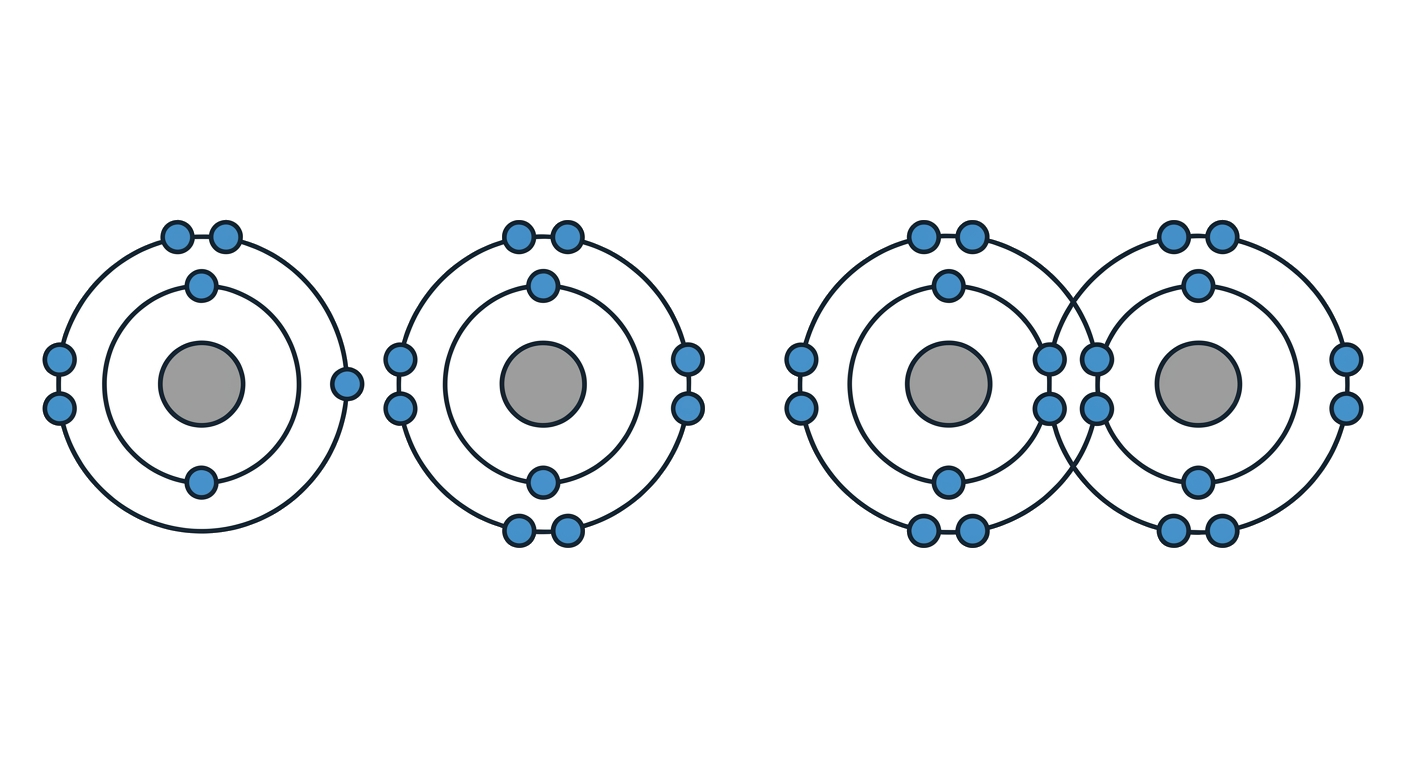
8. Describe the process shown in the illustration, identifying the type of bond formed and the key characteristics of this bonding.
Related Worksheets
Physical and Chemical Properties and Changes
Explore the fundamental concepts of physical and chemical properties and changes through various exercises for Grade 12 Chemistry.
Grade 12 Chemistry: Types of Reactions
A worksheet covering various types of chemical reactions for Grade 12 Chemistry students, including synthesis, decomposition, single displacement, double displacement, combustion, and redox reactions.