Grade 12 Chemistry: Ionic Charges
Explore the formation, properties, and naming conventions of ionic compounds, including polyatomic ions and transition metals.
Includes
Standards
Ionic Charges: Grade 12 Chemistry
Name:
Date:
Score:
Read each question carefully and provide thorough answers based on your understanding of ionic charges and bonding. Show all your work for calculations.
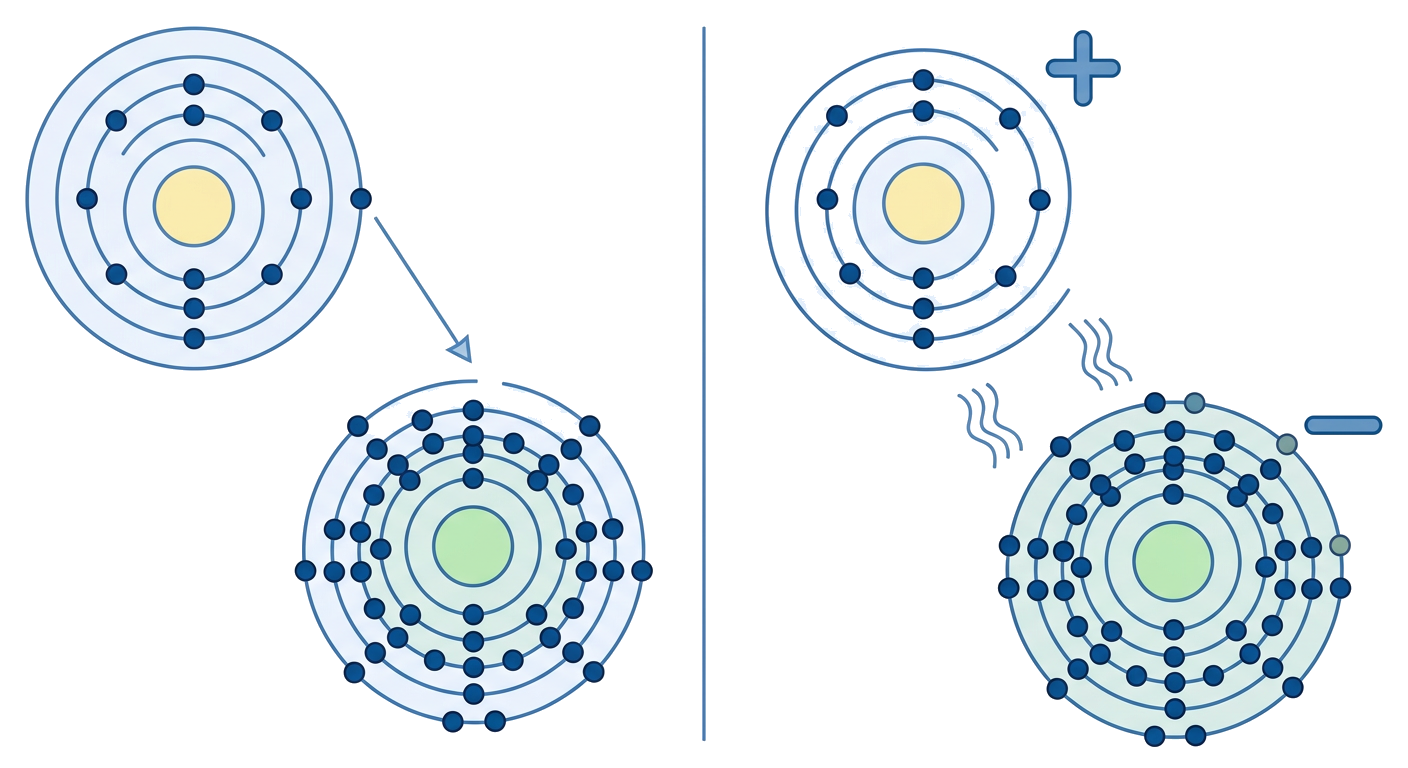
Ionic bonds are formed through the electrostatic attraction between oppositely charged ions. This typically occurs between a metal and a nonmetal, where electrons are transferred from the metal atom to the nonmetal atom.
1. Which of the following elements is most likely to form an ion with a +2 charge?
Sodium (Na)
Chlorine (Cl)
Magnesium (Mg)
Aluminum (Al)
2. What is the correct formula for the ionic compound formed between Calcium and Oxygen?
CaO2
Ca2O
CaO
Ca(OH)2
3. An atom that gains electrons becomes a negatively charged ion called an .
4. The force of attraction between oppositely charged ions is called an bond.
5. Transition metals can often form ions with charges.
6. Explain why ionic compounds typically have high melting and boiling points.
7. Describe the process of electron transfer that occurs when sodium (Na) and chlorine (Cl) form an ionic bond. You may refer to the diagram below for reference.
Match the polyatomic ion with its correct formula and charge.
8. Sulfate
a. NH4+
9. Carbonate
b. CO3^2-
10. Ammonium
c. NO3-
11. Nitrate
d. SO4^2-
12. All ionic compounds are soluble in water.
True
False
13. The Roman numeral in the name of a transition metal ionic compound indicates the number of atoms of that metal.
True
False
14. Write the chemical formula for the following ionic compounds:
a) Aluminum Oxide:
b) Iron(III) Chloride:
c) Potassium Permanganate:
15. Name the following ionic compounds:
a) CuS:
b) (NH4)3PO4:
c) Mg(NO2)2:
Related Worksheets
Physical and Chemical Properties and Changes
Explore the fundamental concepts of physical and chemical properties and changes through various exercises for Grade 12 Chemistry.
Grade 12 Chemistry: Types of Reactions
A worksheet covering various types of chemical reactions for Grade 12 Chemistry students, including synthesis, decomposition, single displacement, double displacement, combustion, and redox reactions.