Ionic Formulas Worksheet
A Grade 12 Chemistry worksheet on understanding and writing ionic formulas, including polyatomic ions and transition metals.
Includes
Standards
Ionic Formulas Worksheet
Name:
Date:
Score:
Read each question carefully and provide your answers in the space provided. Show all your work for calculations.
Ionic bonds are formed between a metal and a nonmetal, involving the transfer of electrons to form ions. The resulting electrostatic attraction between these oppositely charged ions creates a stable ionic compound.
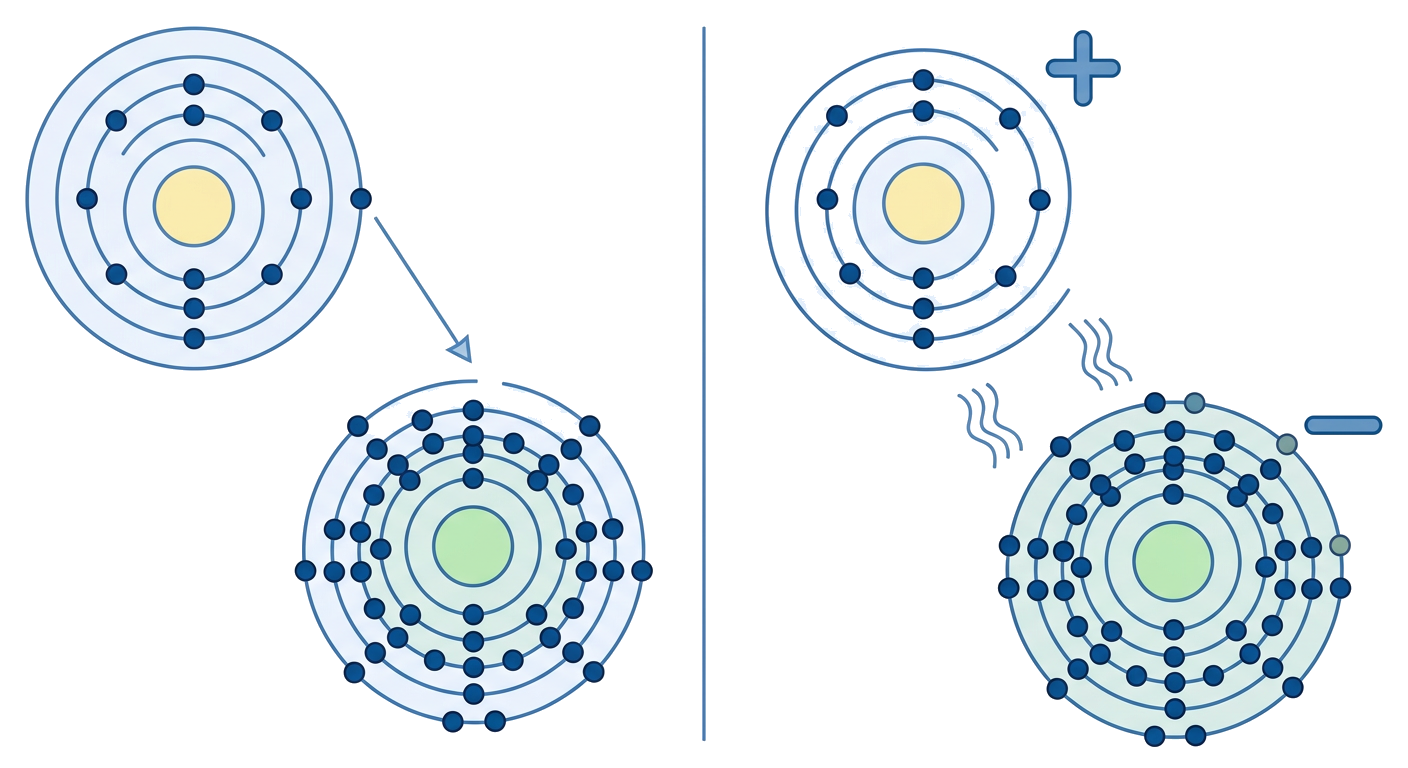
Complete the following statements about ionic compounds:
1. Ionic compounds are formed between a and a .
2. When forming an ionic bond, metals tend to electrons and become charged ions called .
3. Nonmetals tend to electrons and become charged ions called .
4. The overall charge of an ionic compound must always be .
Write the correct chemical formula for the following ionic compounds:
1. Sodium chloride
2. Magnesium oxide
3. Aluminum sulfide
4. Calcium bromide
Write the correct chemical formula for the following ionic compounds containing polyatomic ions:
1. Sodium sulfate
2. Ammonium chloride
3. Calcium nitrate
4. Aluminum phosphate
Write the correct chemical formula for the following ionic compounds with transition metals (remember to use Roman numerals for their charge):
1. Iron(III) oxide
2. Copper(II) bromide
3. Lead(IV) iodide
4. Chromium(III) sulfate
1. Which of the following is the correct formula for magnesium phosphate?
MgPO4
Mg2(PO4)3
Mg3(PO4)2
Mg(PO4)2
2. What is the charge on the iron ion in Fe2S3?
+1
+2
+3
+6
Explain why ionic compounds typically have high melting points and are good conductors of electricity when molten or dissolved in water, but not in their solid state.
Related Worksheets
Physical and Chemical Properties and Changes
Explore the fundamental concepts of physical and chemical properties and changes through various exercises for Grade 12 Chemistry.
Grade 12 Chemistry: Types of Reactions
A worksheet covering various types of chemical reactions for Grade 12 Chemistry students, including synthesis, decomposition, single displacement, double displacement, combustion, and redox reactions.