Grade 12 Chemistry: Neutralization Reactions
This worksheet covers the fundamental concepts of neutralization reactions, including definitions, products, and stoichiometry, suitable for Grade 12 Chemistry students.
Includes
Standards
Topics
Neutralization Reactions Worksheet
Name:
Date:
Score:
Read each question carefully and provide concise answers. Show all your work for calculations.
1. What are the general products of a neutralization reaction between an acid and a base?
Acid and Water
Salt and Water
Base and Salt
Acid and Base
2. Which of the following pH values indicates a neutral solution?
2
7
10
14
1. A neutralization reaction is a chemical reaction in which an acid and a base react quantitatively with each other to form and .
2. The point at which an acid and a base have completely reacted with each other in a titration is called the point.
1. All neutralization reactions produce a neutral solution (pH=7).
True
False
2. The reaction between hydrochloric acid (HCl) and sodium hydroxide (NaOH) is a neutralization reaction.
True
False
1. Write the balanced chemical equation for the neutralization reaction between sulfuric acid (H₂SO₄) and potassium hydroxide (KOH).
2. Explain the role of an indicator in a titration involving a neutralization reaction.
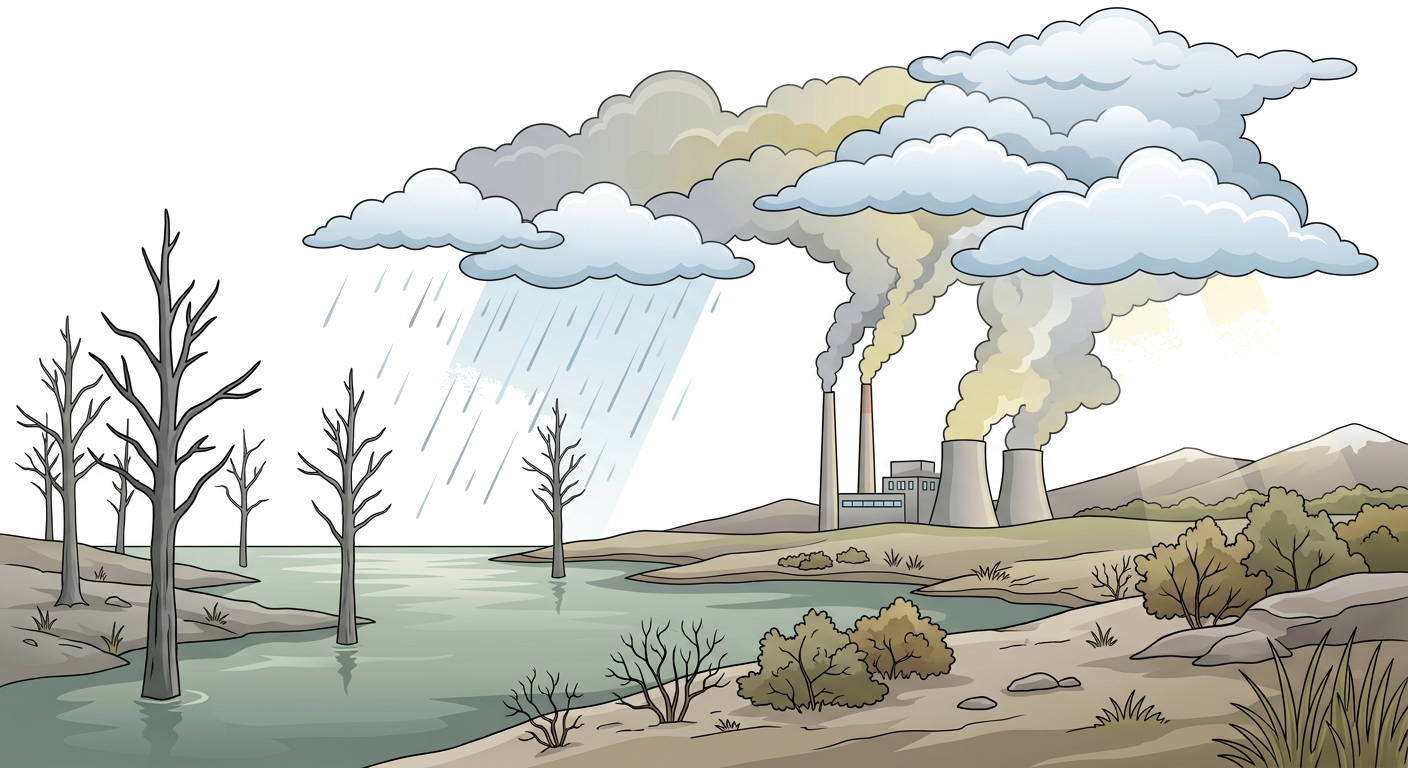
The image below illustrates the concept of acid rain. Acid rain is a real-world example of neutralization reactions occurring in the environment, albeit on a larger scale. The pollutants (acidic gases) react with water and other chemicals to form acidic precipitation, which can then react with basic substances in the environment.
Related Worksheets
Physical and Chemical Properties and Changes
Explore the fundamental concepts of physical and chemical properties and changes through various exercises for Grade 12 Chemistry.
Grade 12 Chemistry: Types of Reactions
A worksheet covering various types of chemical reactions for Grade 12 Chemistry students, including synthesis, decomposition, single displacement, double displacement, combustion, and redox reactions.