Continental Drift: Evidence and Mechanisms
This worksheet explores the theory of continental drift, examining the evidence that supports it and the underlying mechanisms driving plate tectonics.
Includes
Standards
Continental Drift: Evidence and Mechanisms
Name:
Date:
Score:
Read each question carefully and provide detailed answers based on your understanding of continental drift and plate tectonics.
1. Which of the following was NOT a primary piece of evidence used by Alfred Wegener to support his theory of continental drift?
Fit of the continents
Distribution of fossil species
Paleomagnetic striping on the seafloor
Similar rock types and mountain ranges
2. The driving force behind the movement of tectonic plates is primarily:
Gravitational pull of the moon
Convection currents in the mantle
Earth's rotation
Ocean currents
3. The supercontinent that existed approximately 300 million years ago was called .
4. The process by which new oceanic crust is formed at mid-ocean ridges and then moves away from the ridge is known as .
5. The theory of continental drift was widely accepted by the scientific community immediately after its proposal by Alfred Wegener.
True
False
6. Subduction zones are areas where oceanic crust is created.
True
False
7. Briefly explain the concept of seafloor spreading and its role in supporting the theory of continental drift.
8. Describe how the distribution of glacial deposits provides evidence for continental drift.
9. The image below illustrates the sequence of continental movement over geological time. Analyze the sequence and answer the following questions.
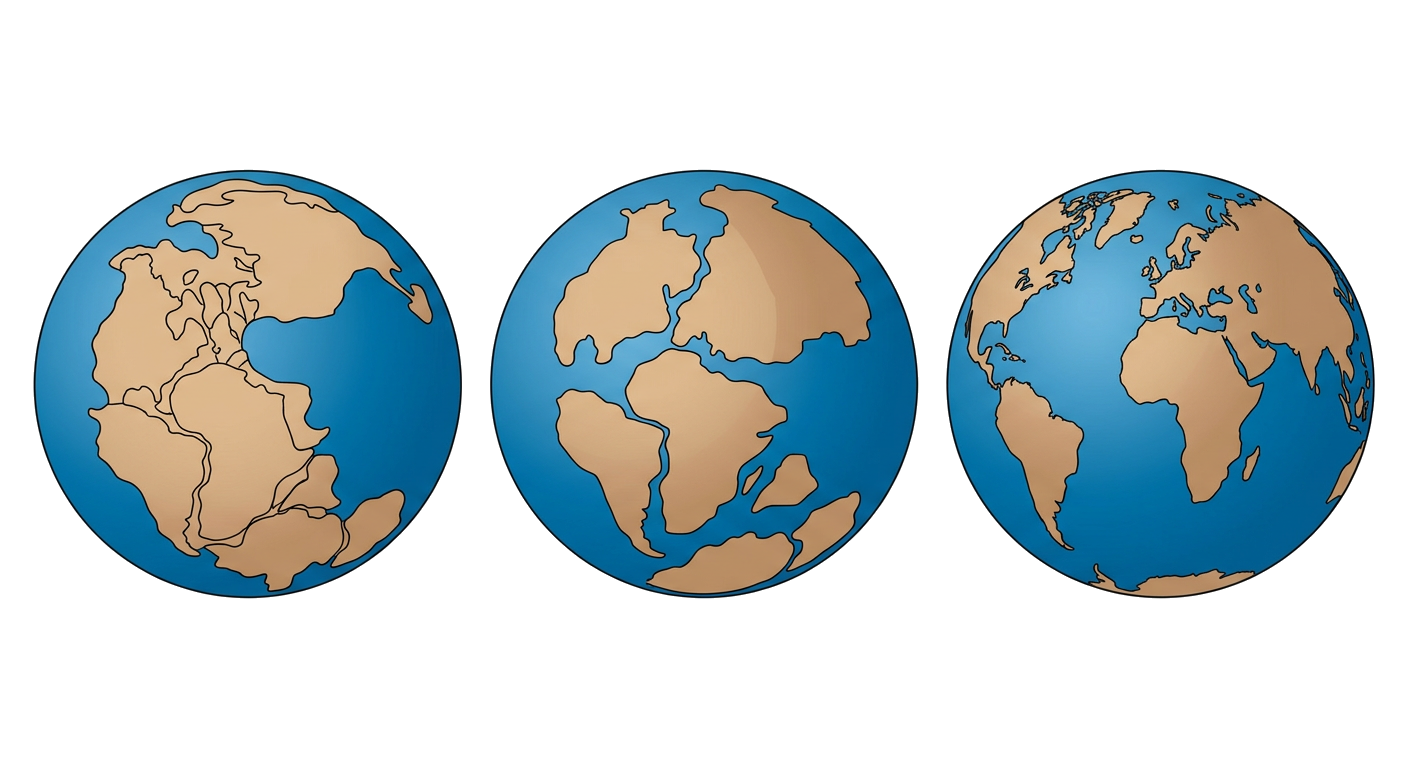
a) What is the name of the supercontinent shown in the earliest stage?
b) Identify at least two significant changes in continental configuration that occurred between the Mesozoic and Cenozoic eras.