Glacier Dynamics and Impact Worksheet
Explore the formation, movement, and environmental effects of glaciers at a Grade 12 level.
Includes
Standards
Topics
Glacier Dynamics and Impact
Name:
Date:
Score:
Read each question carefully and provide thorough answers. Use the provided space for your responses.
1. Which of the following best describes the process of glacial ablation?
Accumulation of snow and ice.
The net loss of ice from a glacier.
The transformation of snow into glacial ice.
The movement of glacial ice downslope.
2. What is the primary driving force behind glacial movement?
Wind erosion
Gravity
Solar radiation
Tectonic plate movement
3. Glaciers form when snow accumulates over time, compacts, and recrystallizes into .
4. The process by which glaciers erode rock by freezing onto surfaces and plucking away fragments is called .
5. Differentiate between continental glaciers and alpine glaciers, providing an example of each.
6. Observe the provided glacier cross-section and answer the following questions.
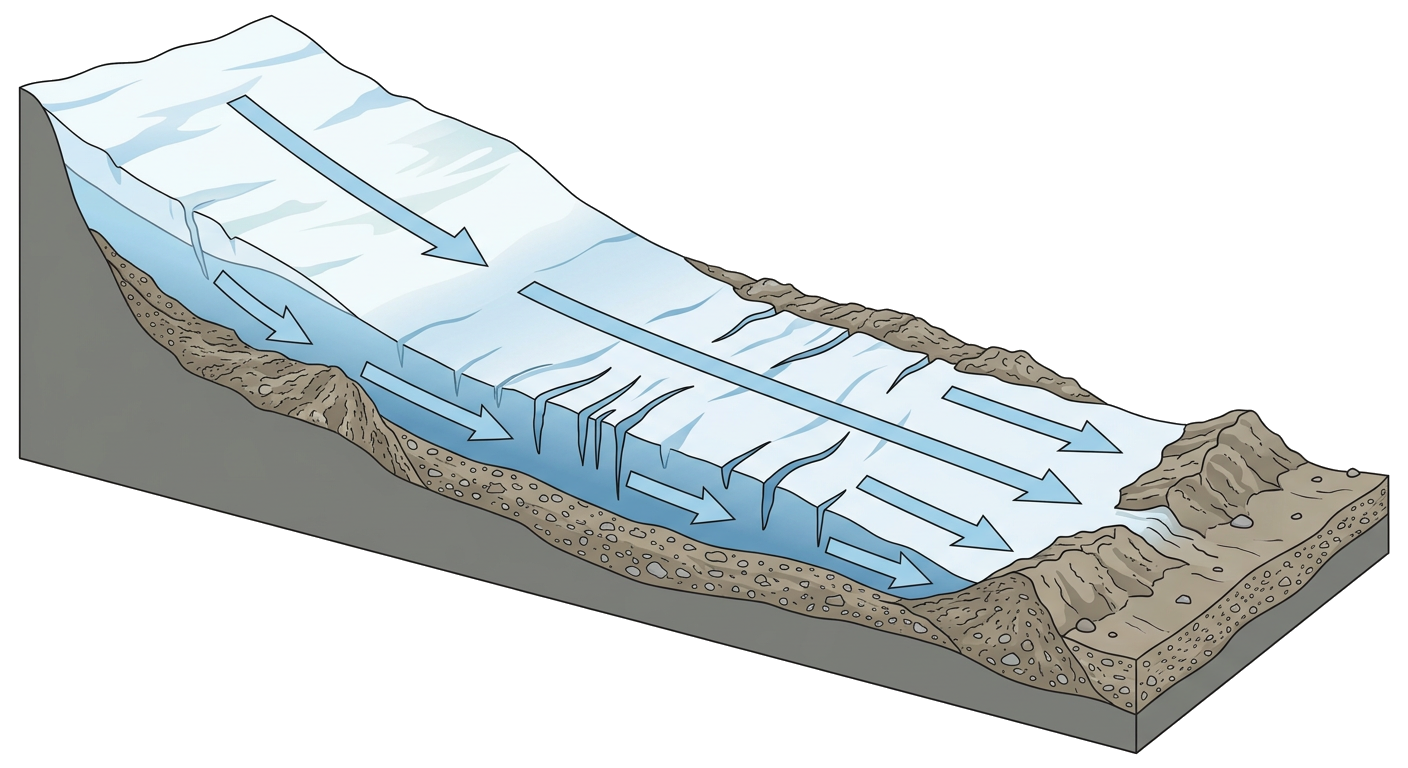
a) Identify and describe the significance of Zone A (accumulation zone) and Zone B (ablation zone) in the diagram.
b) Explain how the balance between accumulation and ablation affects the overall mass and movement of the glacier.
7. Glacial striations are formed by the deposition of sediment at the glacier's snout.
True
False
8. A fjord is a long, narrow, deep inlet of the sea between high cliffs, typically formed by submergence of a glaciated valley.
True
False
9. Discuss the significant impacts of global climate change on glaciers worldwide. Include at least three distinct environmental consequences and potential societal repercussions.