Greenhouse Gases and Climate Change
A Grade 12 science worksheet exploring the causes, effects, and mitigation strategies related to greenhouse gases and climate change.
Includes
Standards
Topics
Greenhouse Gases and Climate Change
Name:
Date:
Score:
Read each question carefully and provide thorough answers. Use complete sentences and scientific terminology where appropriate.
1. Which of the following is considered the most significant anthropogenic greenhouse gas?
Methane (CH4)
Nitrous Oxide (N2O)
Carbon Dioxide (CO2)
Water Vapor (H2O)
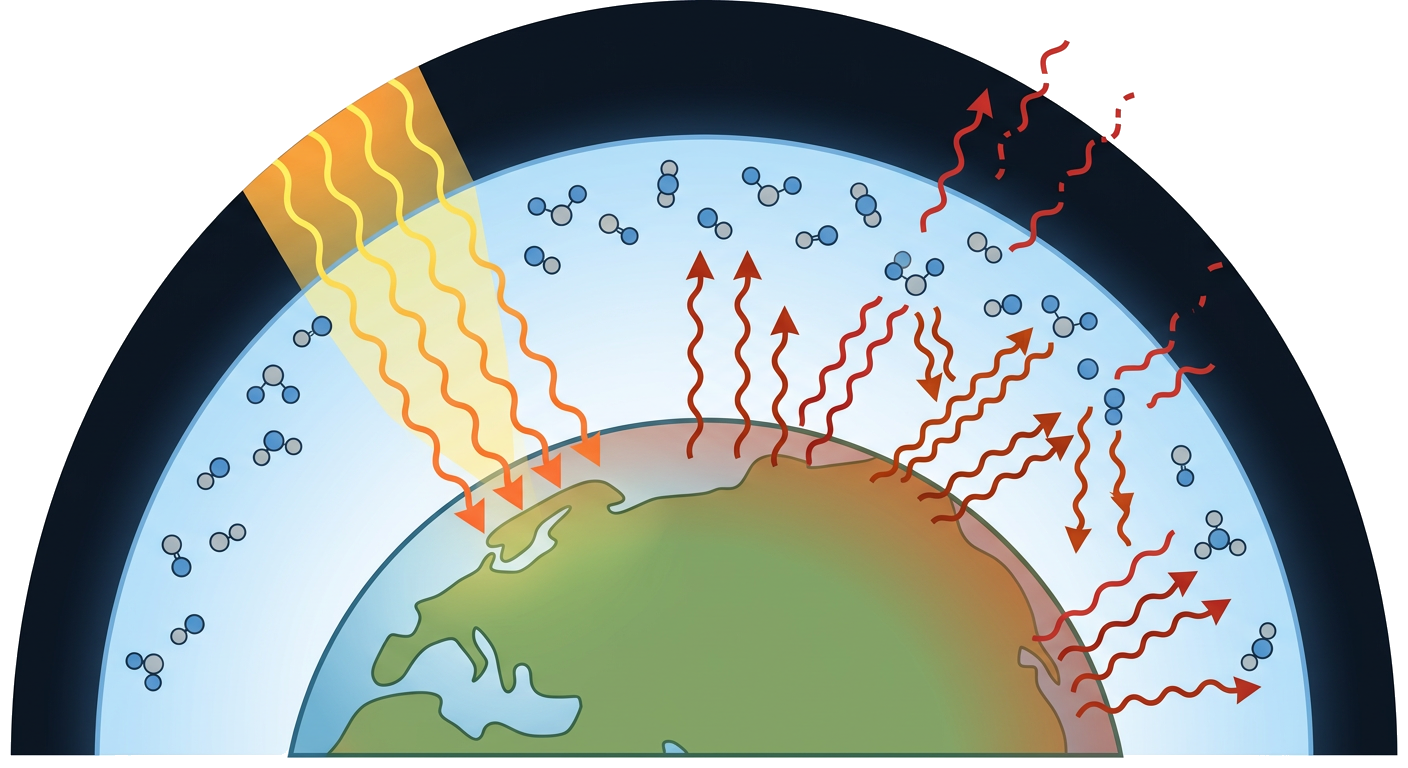
2. The illustration below demonstrates the natural process of the greenhouse effect. Explain how human activities intensify this process, leading to global warming.
Increased reflection of solar radiation by aerosols.
Enhancement of the ozone layer, trapping more heat.
Release of additional greenhouse gases from burning fossil fuels.
Decreased absorption of infrared radiation by the oceans.
3. The primary source of anthropogenic methane emissions is , while nitrous oxide is largely produced by .
4. The warming potential of a greenhouse gas is measured by its , which considers its ability to absorb heat and its atmospheric lifetime.
5. Describe two significant impacts of increased greenhouse gas concentrations on global climate patterns, providing specific examples for each.
6. Explain the concept of 'climate feedback loops' in the context of greenhouse gases and provide one example of a positive feedback loop.
7. Deforestation contributes to an increase in atmospheric carbon dioxide.
True
False
8. Water vapor is the strongest greenhouse gas, but its concentration is not directly controlled by human emissions.
True
False
9. Discuss the various international efforts and agreements aimed at reducing greenhouse gas emissions. Evaluate their effectiveness and identify the major challenges encountered in achieving global consensus and implementation.