Earthquake Location Principles
Grade 12 Science worksheet on understanding seismic waves, seismographs, and the triangulation method for locating earthquake epicenters.
Includes
Standards
Earthquake Location Principles
Name:
Date:
Score:
Read each question carefully and answer to the best of your knowledge. This worksheet assesses your understanding of earthquake characteristics and location methods.
1. Which type of seismic wave travels fastest and is the first to arrive at a seismograph station?
S-waves
P-waves
Love waves
Rayleigh waves
2. The difference in arrival times between P-waves and S-waves at a seismic station is primarily used to determine the:
Magnitude of the earthquake
Depth of the earthquake focus
Distance to the epicenter
Type of fault involved
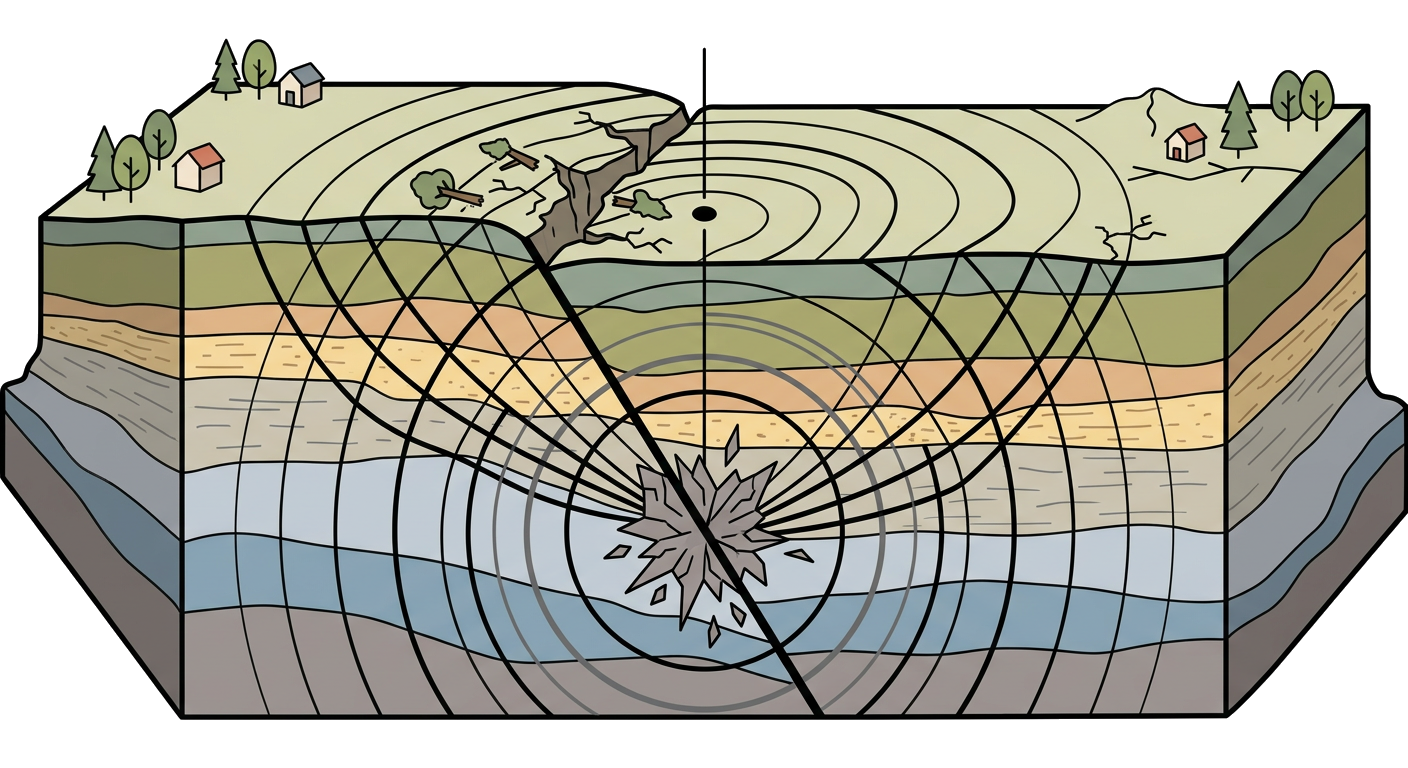
3. The point on the Earth's surface directly above the earthquake's origin is called the .
4. The method used to locate an earthquake's epicenter using data from at least three seismic stations is known as .
5. S-waves cannot travel through , which provides evidence for the Earth's liquid outer core.
6. Describe the key difference in particle motion between P-waves and S-waves.
7. Refer to the seismogram below. If the P-wave arrived at 10:00:00 AM and the S-wave arrived at 10:00:45 AM, calculate the S-P travel time difference. Explain how this difference is used to determine the distance to the earthquake epicenter.
8. Surface waves are generally more destructive than body waves.
True
False
9. The Richter scale measures the intensity of an earthquake, which is based on observed effects.
True
False
10. Discuss the importance of having a global network of seismograph stations for accurately locating earthquakes, especially those occurring in remote oceanic areas.