Relative Age Dating Worksheet
Explore the principles of relative age dating, including superposition, original horizontality, cross-cutting relationships, and inclusions, with this Grade 12 science worksheet.
Includes
Standards
Topics
Relative Age Dating
Name:
Date:
Score:
Read each question carefully and answer to the best of your ability. Refer to the provided diagrams as needed.
1. Which principle states that in an undisturbed sequence of sedimentary strata, the oldest layer is at the bottom and the youngest is at the top?
Principle of Original Horizontality
Principle of Superposition
Principle of Cross-Cutting Relationships
Principle of Inclusions
2. An igneous intrusion cuts through several layers of sedimentary rock. According to the Principle of Cross-Cutting Relationships, which is older?
The igneous intrusion
The sedimentary layers
They are the same age
Cannot be determined
3. The Principle of Original states that layers of sediment are originally deposited horizontally.
4. Fragments of one rock unit enclosed within another rock unit are called .
5. A break in the geologic record, such as an erosional surface, is known as an .
6. The Principle of Faunal Succession states that fossil organisms succeed one another in a definite and determinable order.
True
False
7. A disconformity is a type of unconformity where sedimentary layers are deposited directly on top of eroded igneous or metamorphic rocks.
True
False
8. Observe the diagram below:
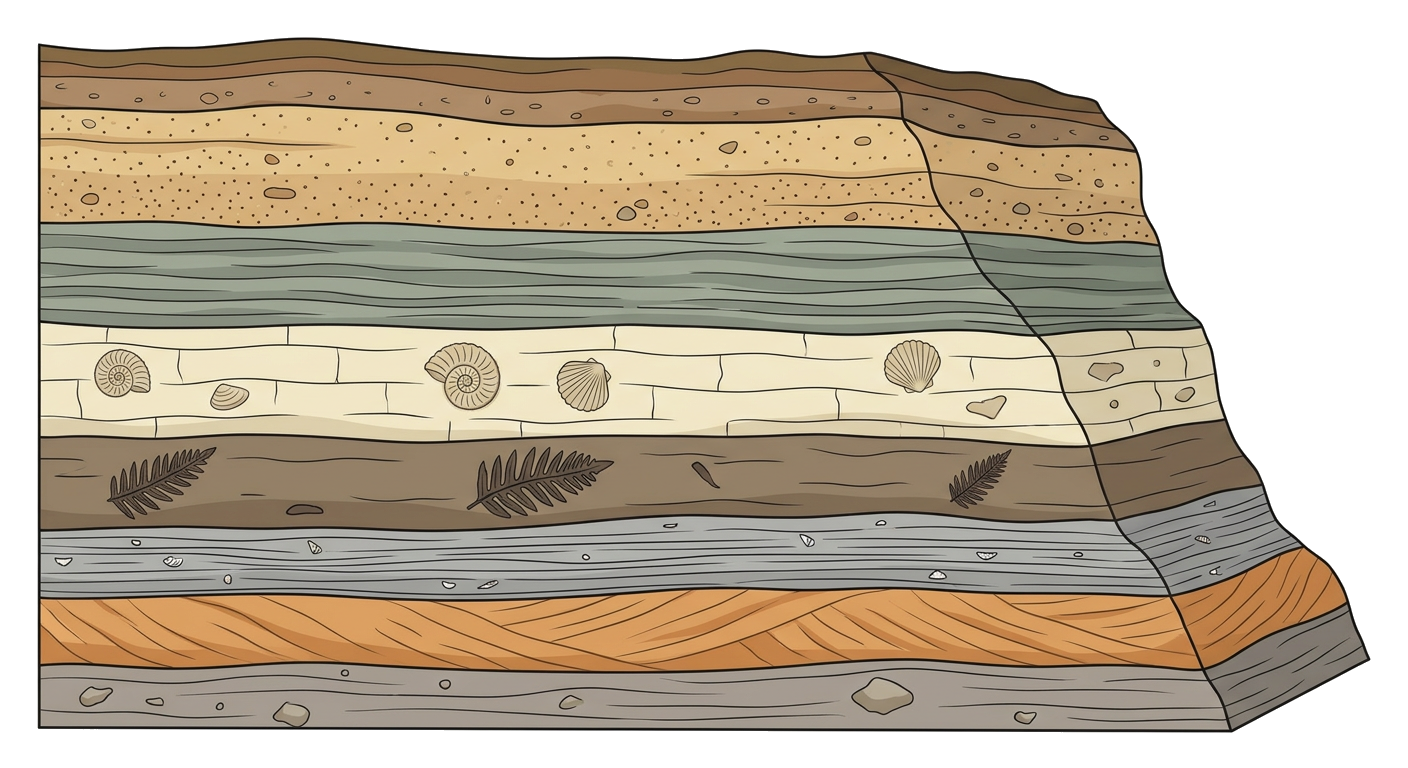
Based on the Principle of Superposition, identify the oldest and youngest layers in the diagram.
9. Explain the difference between a conformable contact and an unconformity.
Match each principle of relative dating with its description.
10. Superposition
a. Sediments are deposited in flat layers.
11. Original Horizontality
b. Older features are cut by younger features.
12. Cross-Cutting Relationships
c. Older rock fragments are found within a younger rock unit.
13. Inclusions
d. Oldest layers are at the bottom, youngest at the top.