Sedimentary Rocks: Formation and Characteristics
Explore the formation processes, classification, and key characteristics of sedimentary rocks at a Grade 12 level.
Includes
Standards
Topics
Sedimentary Rocks: Formation and Characteristics
Name:
Date:
Score:
Read each question carefully and provide thorough answers based on your understanding of sedimentary rocks.
1. Which of the following processes is NOT directly involved in the formation of sedimentary rocks?
Weathering
Erosion
Metamorphism
Deposition
2. Clastic sedimentary rocks are primarily classified based on:
Their chemical composition
The size of their constituent grains
The presence of fossils
Their color and hardness
3. The process by which loose sediment is transformed into solid rock is called .
4. Organic sedimentary rocks are formed from the accumulation of .
5. The most abundant chemical sedimentary rock is .
6. Describe the two main processes involved in lithification. What role does each play?
7. Conglomerate is a clastic sedimentary rock characterized by rounded, gravel-sized particles.
True
False
8. Evaporites are a type of chemical sedimentary rock formed from the precipitation of minerals from water.
True
False
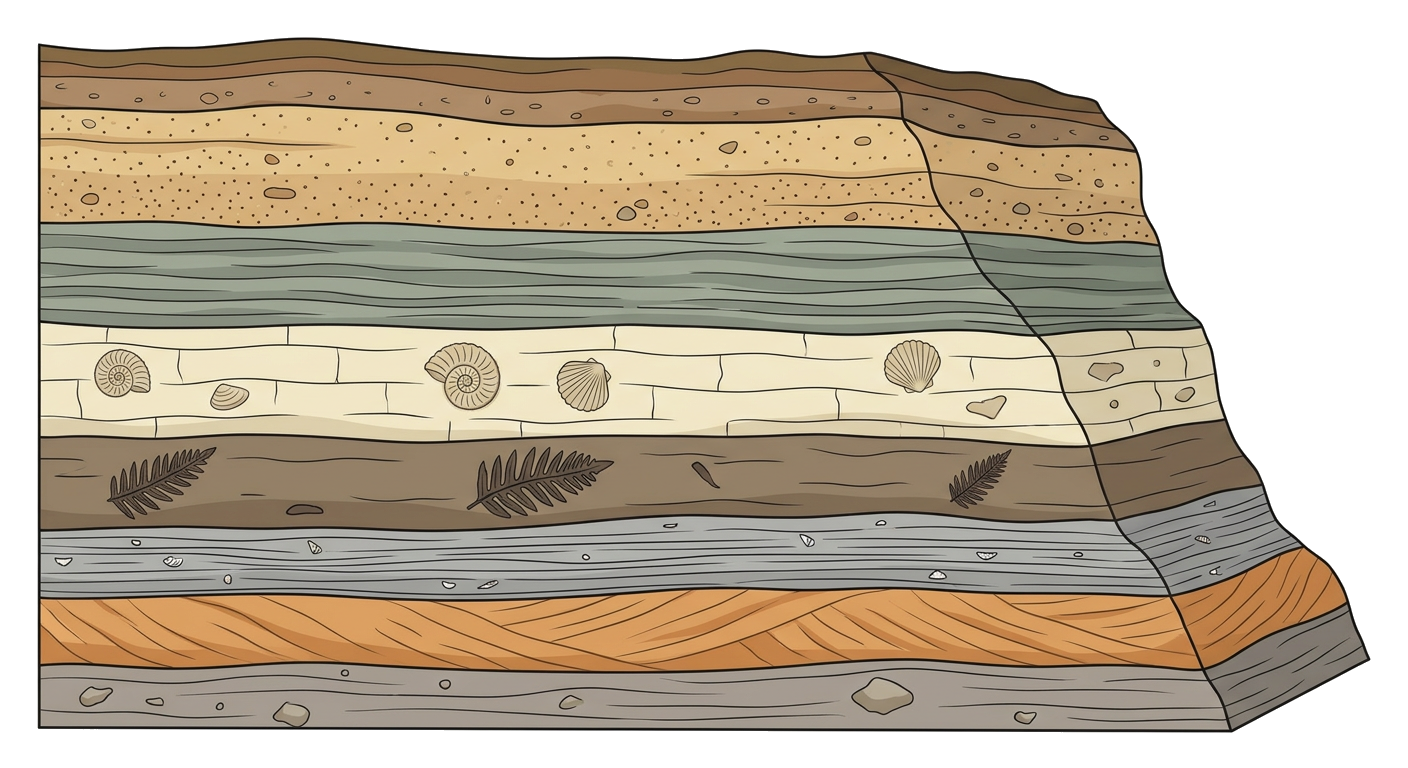
9. Observe the diagram of sedimentary layers below. In the space provided, explain how the principle of superposition helps geologists interpret Earth's history from such layers.
10. Discuss the significance of sedimentary rocks in understanding Earth's past environments, climates, and biological evolution. Provide specific examples of how different types of sedimentary rocks can reveal information about these aspects.