Volcano Types Worksheet
Explore the different types of volcanoes, their formation, characteristics, and eruption styles.
Includes
Standards
Topics
Volcano Types Worksheet
Name:
Date:
Score:
Read each question carefully and answer to the best of your ability. Use complete sentences for short answer questions.
1. Which type of volcano is characterized by broad, gently sloping sides and effusive eruptions of low-viscosity basaltic lava?
Stratovolcano
Cinder Cone
Shield Volcano
Lava Dome
2. Which type of volcano is typically formed from explosive eruptions of pyroclastic material, resulting in a steep, conical shape?
Shield Volcano
Stratovolcano
Cinder Cone
Caldera
3. Volcanoes that form over a concentrated heat source in the mantle, away from plate boundaries, are known as volcanoes.
4. A large, basin-shaped depression formed when the roof of a magma chamber collapses after an eruption is called a .
5. Describe the primary differences in eruption style and magma composition between a shield volcano and a stratovolcano.
6. Identify the types of volcanoes shown in the diagram below and briefly describe one characteristic for each.
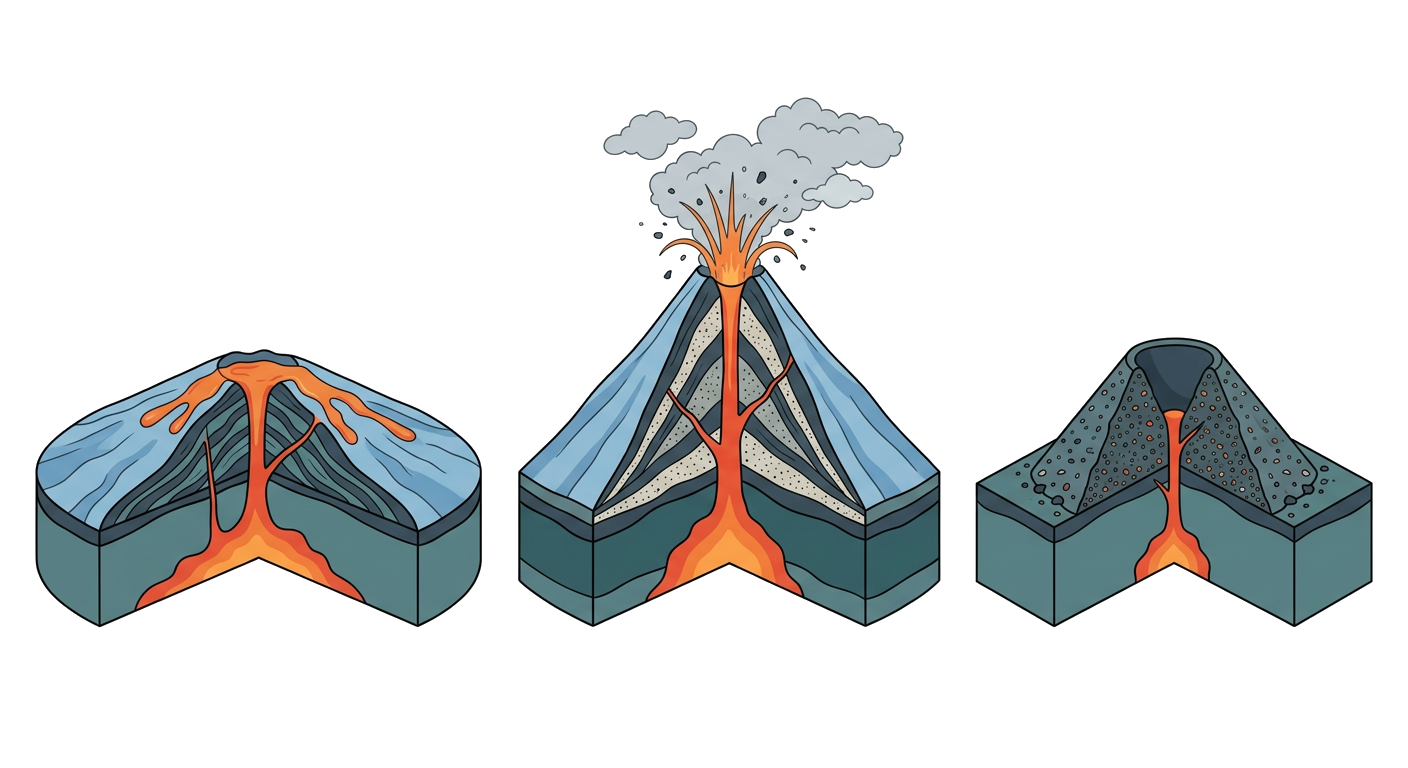
Volcano A:
Characteristic:
Volcano B:
Characteristic:
Volcano C:
Characteristic:
7. Cinder cone volcanoes are typically the largest and most destructive type of volcano.
True
False
8. The Hawaiian Islands are examples of shield volcanoes formed over a hotspot.
True
False
Match the volcano type with its description.
9. Shield Volcano
a. Formed by alternating layers of lava and pyroclastic material
10. Stratovolcano
b. Built almost entirely of fluid lava flows, very broad and gently sloping
11. Cinder Cone
c. Smallest and most common type, built from ejected lava fragments