Volcanoes: Formation, Eruptions, and Impact
Explore the geological processes behind volcanoes, different eruption types, and their environmental and societal impacts.
Includes
Standards
Topics
Volcanoes: Formation, Eruptions, and Impact
Name:
Date:
Score:
Read each question carefully and answer to the best of your ability. For multiple-choice questions, select the best option. For short answer and essay questions, provide detailed and well-reasoned responses.
1. Which type of volcano is characterized by broad, gently sloping sides formed by layers of fluid lava flows?
Stratovolcano
Cinder Cone
Shield Volcano
Lava Dome
2. What type of plate boundary is most commonly associated with the formation of stratovolcanoes and explosive eruptions?
Divergent boundary
Convergent boundary with subduction
Transform boundary
Hotspot
3. The molten rock beneath the Earth's surface is called , while molten rock erupted onto the surface is called .
4. A large, basin-shaped depression formed when the roof of a magma chamber collapses after an eruption is known as a .
5. Describe the primary differences between effusive and explosive volcanic eruptions, including the type of magma involved and the hazards associated with each.
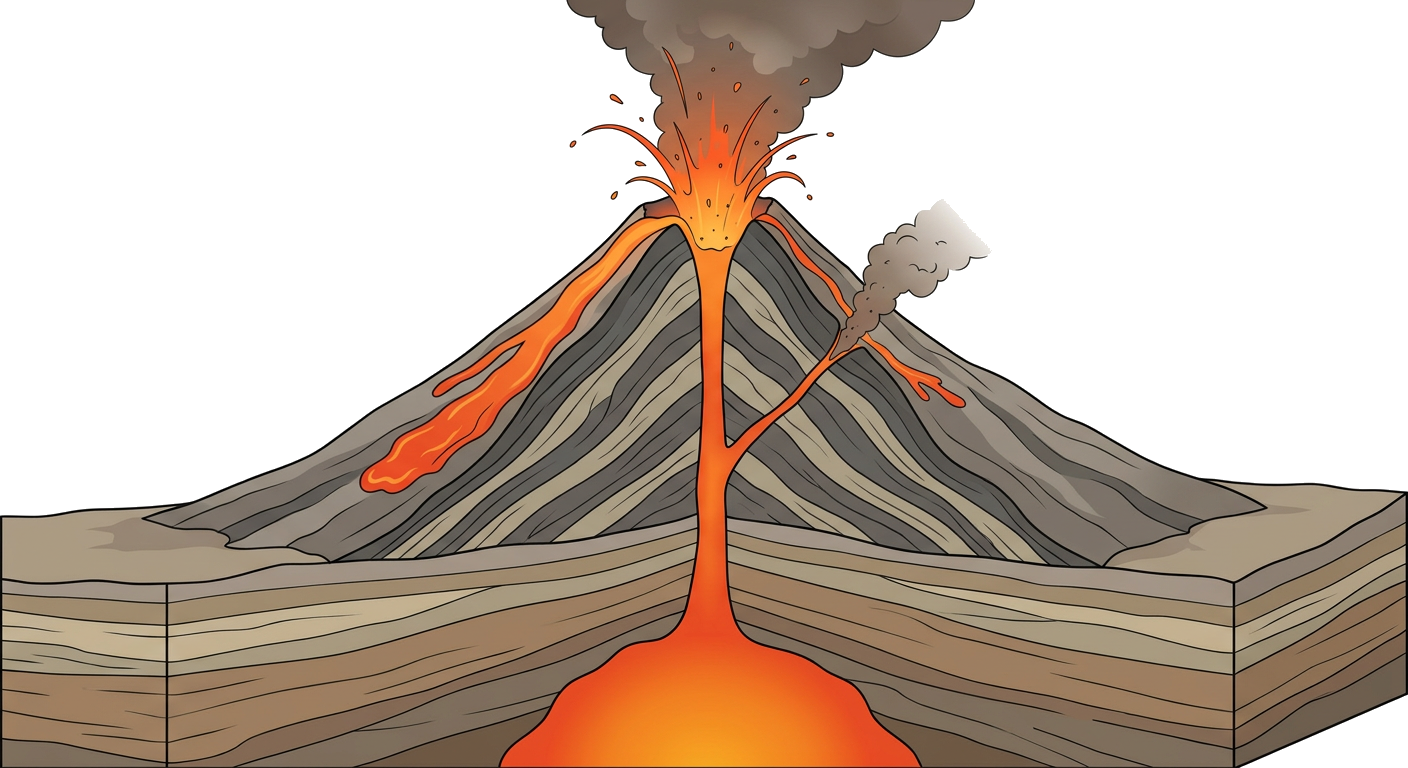
6. Examine the cross-section of the volcano below. Label the following parts on the diagram: Magma Chamber, Conduit (Vent), Crater, Flank, Ash Cloud.
7. The Ring of Fire is a major area in the basin of the Pacific Ocean where a large number of earthquakes and volcanic eruptions occur.
True
False
8. Discuss the environmental and societal impacts of a major volcanic eruption. Provide specific examples of both short-term and long-term effects.