Grade 12 Density Column Worksheet
A comprehensive worksheet for Grade 12 Physical Science students to understand and apply principles of density columns, including calculations, factors affecting density, and real-world applications.
Includes
Standards
Topics
Grade 12 Density Column Worksheet
Name:
Date:
Score:
Read each question carefully and provide detailed answers. Show all your work for calculation-based problems. Use the provided image for reference where applicable.
Density columns are created by carefully layering liquids of different densities, with the most dense liquid at the bottom and the least dense at the top. This phenomenon is governed by the principle of density, defined as mass per unit volume (ρ = m/V).
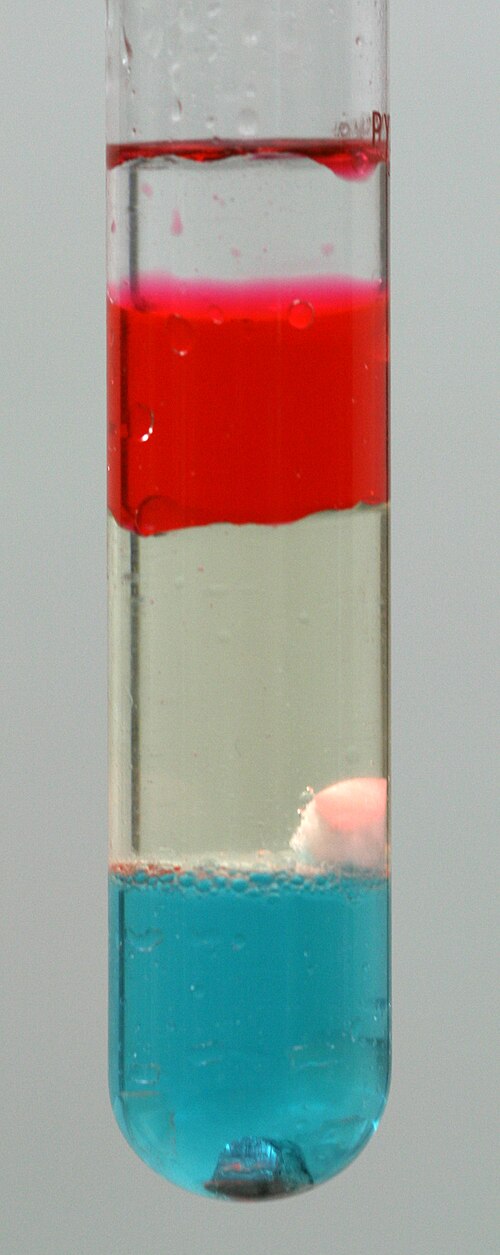
1. Which of the following statements best describes why liquids separate into layers in a density column?
Liquids with higher viscosity sink faster.
Liquids with lower density float on top of liquids with higher density.
Liquids with higher surface tension create stronger bonds.
Liquids with different colors naturally repel each other.
2. If a solid object is placed in a density column and settles between the oil layer (density 0.9 g/mL) and the water layer (density 1.0 g/mL), what can be inferred about the object's density?
It is less than 0.9 g/mL.
It is exactly 1.0 g/mL.
It is between 0.9 g/mL and 1.0 g/mL.
It is greater than 1.0 g/mL.
3. The formula for density is mass divided by .
4. When creating a density column, the liquid with the highest density should be poured in .
5. Temperature can affect the density of a liquid; generally, as temperature increases, density .
6. Explain the concept of immiscibility and its importance in forming stable density columns.
7. Describe two real-world applications where the principle of density columns is utilized.
8. A liquid with a density of 1.2 g/mL will float on a liquid with a density of 1.0 g/mL.
True
False
9. Sugar water can be used as a layer in a density column because sugar dissolves in water, increasing its density.
True
False
10. You are tasked with creating a density column using four liquids: honey (density 1.4 g/mL), vegetable oil (density 0.9 g/mL), water (density 1.0 g/mL), and rubbing alcohol (density 0.79 g/mL). A small plastic bead (mass 5.0 g, volume 4.5 mL) is dropped into the column. Describe the order in which you would pour the liquids to create a stable column and predict where the plastic bead would settle. Justify your answer with calculations.