Grade 12 Physics: Magnetic Forces, Fields, and Faraday's Law
Explore magnetic forces on charges and currents, understand magnetic fields, and delve into Faraday's Law of electromagnetic induction.
Includes
Standards
Topics
Magnetic Forces, Fields, and Faraday's Law
Name:
Date:
Score:
Read each question carefully and provide your best answer. Show all your work for calculations.
1. Which of the following statements about magnetic field lines is TRUE?
They originate from the south pole and end at the north pole.
They cross each other at points of strong magnetic field.
Their density indicates the strength of the magnetic field.
They are purely theoretical constructs and have no physical meaning.
2. A charged particle moving parallel to a uniform magnetic field will experience:
a magnetic force perpendicular to its velocity.
a magnetic force in the direction of its velocity.
no magnetic force.
a magnetic force opposite to its velocity.
3. Faraday's Law of Induction states that the magnitude of the induced electromotive force (EMF) in a circuit is proportional to the rate at which the through the circuit is changing.
4. The direction of the magnetic force on a current-carrying wire in a magnetic field can be determined using the hand rule.
5. Describe the key characteristics of magnetic field lines. You may refer to the diagram below.
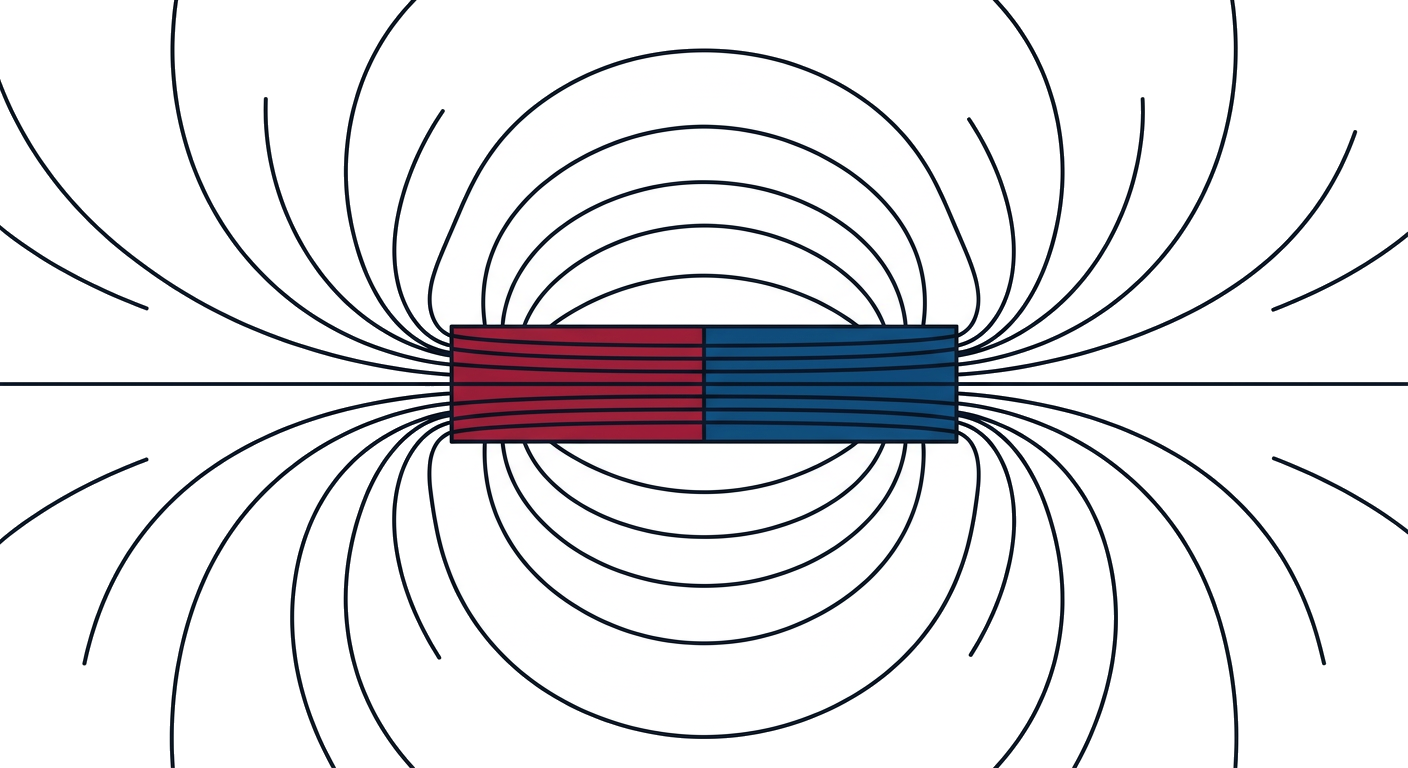
6. A proton moves with a speed of 3.0 x 10^6 m/s through a uniform magnetic field of 2.5 T. If the angle between the proton's velocity and the magnetic field is 60 degrees, calculate the magnitude of the magnetic force on the proton. (Charge of a proton = 1.6 x 10^-19 C)
7. A stationary charge will experience a magnetic force in a uniform magnetic field.
True
False
8. Increasing the number of turns in a coil will increase the induced EMF, according to Faraday's Law.
True
False
Match the term on the left with its definition on the right.
9. Magnetic Flux
a. The force experienced by a moving charge in a magnetic field.
10. Lorentz Force
b. The number of magnetic field lines passing through a given area.
11. Electromotive Force (EMF)
c. The potential difference generated by a changing magnetic flux.
12. Explain Faraday's Law of Electromagnetic Induction and discuss two real-world applications of this principle. Your explanation should include the mathematical relationship and the factors affecting the induced EMF.