Nuclear Power: Principles and Applications
Explore the fundamental principles of nuclear power, including fission, fusion, reactor types, and the associated benefits and risks.
Includes
Standards
Topics
Nuclear Power: Principles and Applications
Name:
Date:
Score:
Read each question carefully and answer to the best of your knowledge. For multiple-choice questions, select the best option. For short answer and fill-in-the-blank questions, write your answers in the space provided.
1. Which of the following best describes nuclear fission?
The combining of two light nuclei to form a heavier nucleus.
The splitting of a heavy nucleus into two or more lighter nuclei.
The spontaneous decay of an unstable atomic nucleus.
The process of converting mass into energy through chemical reactions.
2. What is the primary function of control rods in a nuclear reactor?
To generate electricity.
To moderate the speed of neutrons.
To absorb excess neutrons and control the chain reaction.
To cool the reactor core.
3. Nuclear fusion is the process that powers the .
4. The element most commonly used as fuel in nuclear fission reactors is .
5. Briefly explain the concept of a nuclear chain reaction.
6. Discuss one advantage and one disadvantage of nuclear power compared to fossil fuels.
7. Refer to the diagram of a nuclear power plant below and identify the labeled components.
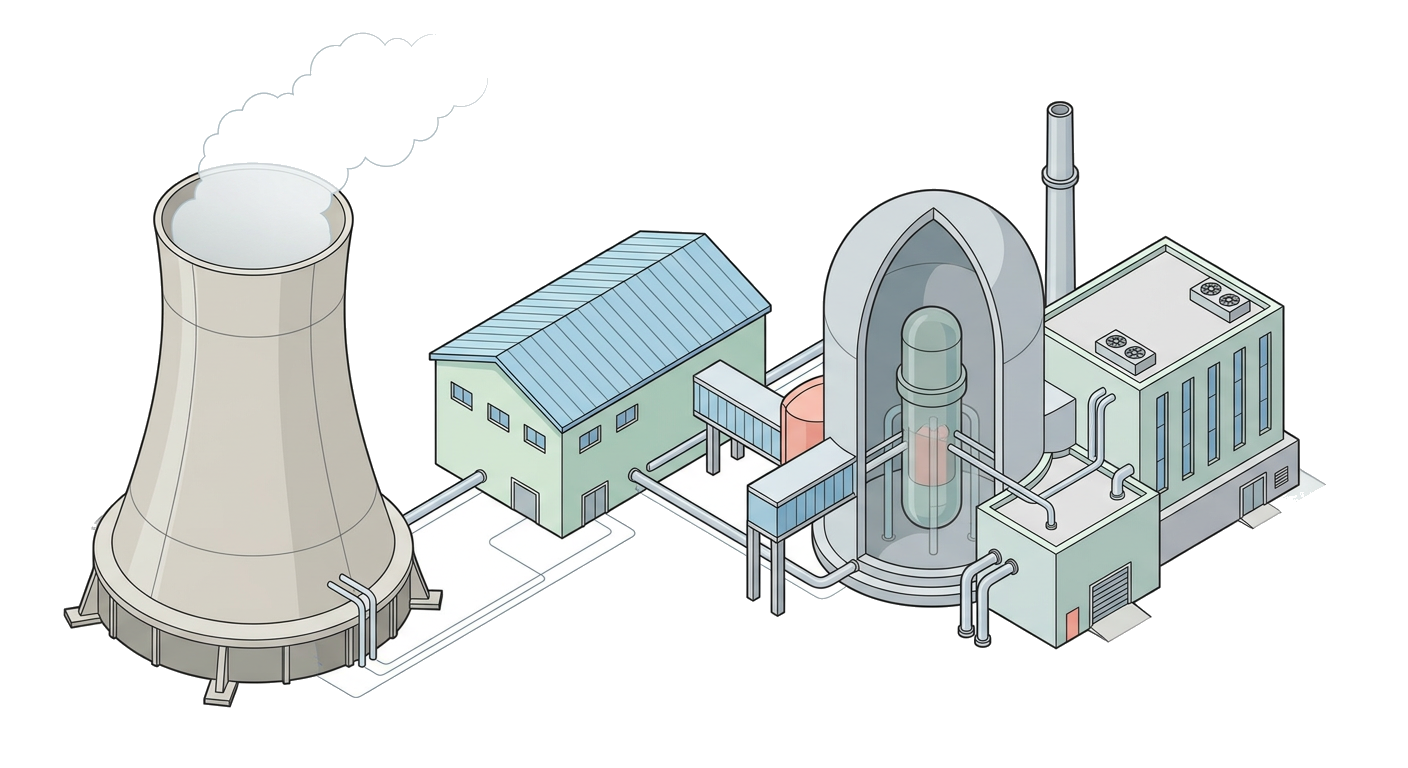
A:
B:
C:
D:
8. Nuclear waste remains radioactive for only a few years.
True
False
9. Nuclear fusion produces more energy than nuclear fission.
True
False
Use the words below to complete the sentences.
10. The minimum amount of fissile material needed to sustain a nuclear chain reaction is called the .
11. A is a material used in nuclear reactors to slow down fast neutrons.