Series and Parallel Resistors Worksheet
Explore the fundamental concepts of series and parallel resistor circuits, calculate equivalent resistance, current, and voltage in various configurations.
Includes
Standards
Topics
Series and Parallel Resistors
Name:
Date:
Score:
Read each question carefully and provide your answers in the spaces provided. Show all your work for calculations.
1. What happens to the total resistance when resistors are added in series?
It decreases.
It increases.
It remains the same.
It depends on the resistance values.
2. In a parallel circuit, what is true about the voltage across each resistor?
It is divided among the resistors.
It is the same across each resistor.
It is inversely proportional to the resistance.
It is proportional to the resistance.
1. The formula for equivalent resistance in a series circuit is R_eq = .
2. In a parallel circuit, the reciprocal of the equivalent resistance is equal to the sum of the of the individual resistances.
3. If one resistor in a series circuit breaks, the entire circuit .
1. Three resistors with values of 10 Ω, 20 Ω, and 30 Ω are connected in series to a 12V battery.

a) Calculate the total equivalent resistance of the circuit.
b) Calculate the total current flowing through the circuit.
2. Two resistors, 15 Ω and 25 Ω, are connected in parallel to a 9V battery.
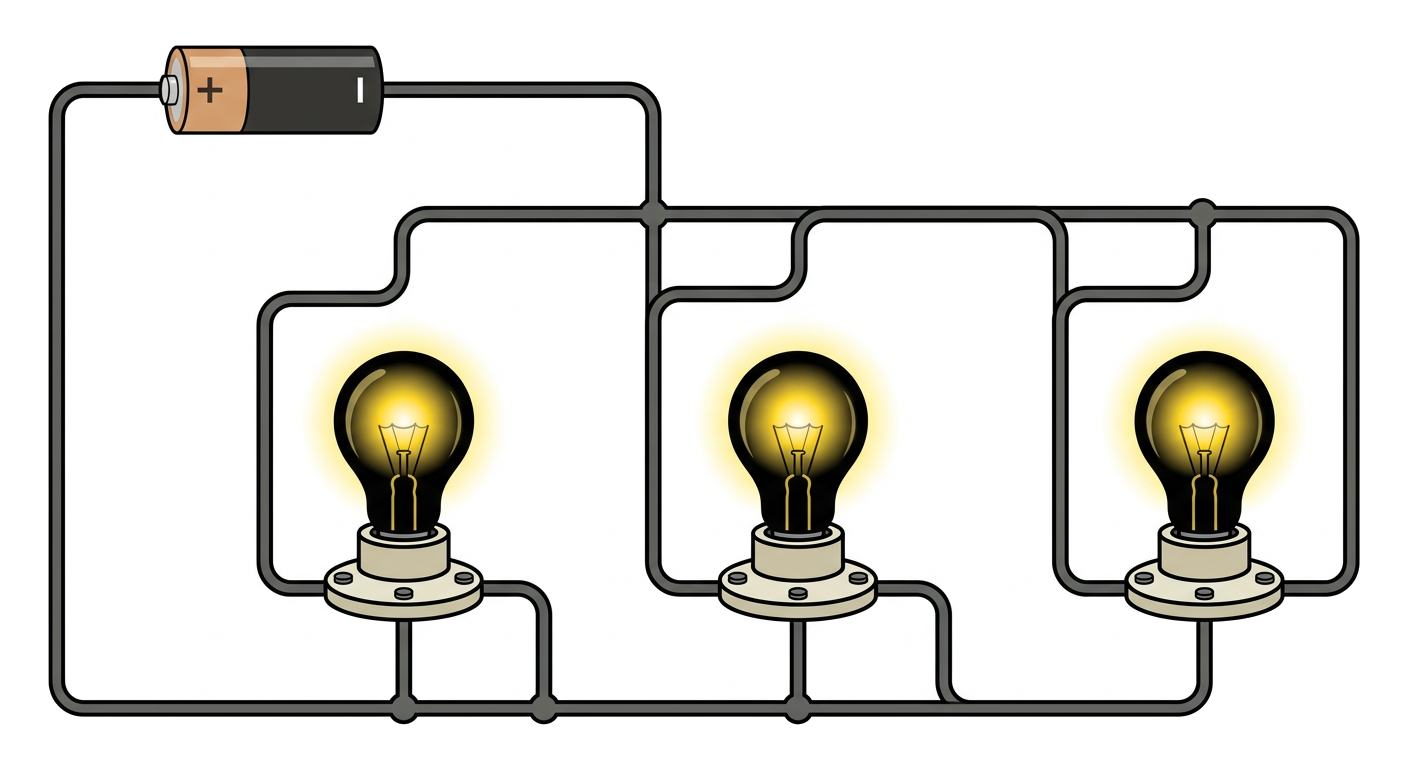
a) Calculate the total equivalent resistance of the circuit.
b) Calculate the total current drawn from the battery.
1. The current is the same through all components in a parallel circuit.
True
False
2. Adding more resistors in parallel decreases the total equivalent resistance.
True
False
Match each term with its correct definition.
1. Series Circuit
a. Components are connected across each other, providing multiple paths for current.
2. Parallel Circuit
b. Components are connected end-to-end, forming a single path for current.
3. Equivalent Resistance
c. The total resistance of a circuit with multiple resistors.