Ultrasound Physics Worksheet
Grade 12 physics worksheet covering the principles, applications, and safety of ultrasound technology.
Includes
Standards
Topics
Ultrasound Physics Worksheet
Name:
Date:
Score:
Read each question carefully and provide detailed answers based on your understanding of ultrasound physics. Show all calculations where applicable.
1. Which of the following best describes ultrasound?
Sound waves with frequencies below 20 Hz
Electromagnetic waves used for imaging
Sound waves with frequencies above 20 kHz
Light waves used for therapeutic purposes
2. The piezoelectric effect is crucial for ultrasound transducers because it:
Amplifies the sound waves produced
Converts electrical energy to mechanical vibrations and vice versa
Focuses the ultrasound beam
Absorbs reflected sound waves
3. The principle behind ultrasound imaging is the effect, where sound waves are reflected at interfaces between tissues with different impedances.
4. The effect describes the change in frequency of a wave for an observer moving relative to its source, which is used in ultrasound to measure blood flow.
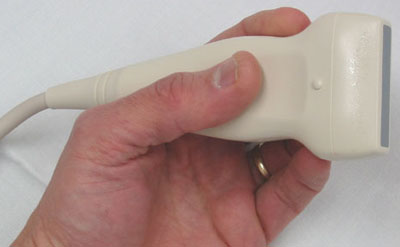
5. Explain how an ultrasound transducer generates and detects ultrasound waves. You may refer to the image of an ultrasound transducer below.
6. Discuss two common medical applications of ultrasound and briefly explain the physics principle that makes each application possible.
7. Higher frequency ultrasound waves provide better resolution but penetrate less deeply into tissues.
True
False
8. Ultrasound imaging involves the use of ionizing radiation, similar to X-rays.
True
False
9. An ultrasound pulse travels through tissue at a speed of 1540 m/s. If the pulse takes 50 µs (microseconds) to travel from the transducer to a reflector and back, what is the distance to the reflector?