Accuracy vs. Precision in Measurement
Explore the concepts of accuracy and precision in scientific measurements, their differences, and their importance in experimental design and data analysis for Grade 12 science students.
Includes
Standards
Topics
Accuracy vs. Precision in Measurement
Name:
Date:
Score:
Read each question carefully and provide thoughtful answers. This worksheet will test your understanding of accuracy and precision in scientific contexts.
1. Which of the following best describes accuracy in scientific measurement?
How close repeated measurements are to each other.
How close a measurement is to the true or accepted value.
The number of significant figures in a measurement.
The consistency of a measuring instrument.
2. A scientist measures the mass of a known 10.00g standard three times and obtains values of 9.98g, 9.99g, and 10.01g. These measurements are considered:
Accurate but not precise
Precise but not accurate
Both accurate and precise
Neither accurate nor precise
3. A measuring device that consistently gives readings that are slightly off from the true value is said to have a error.
4. To improve the of a measurement, a scientist should reduce random errors by taking multiple readings and averaging them.
5. A measurement is one that is very close to the true value, while a measurement is one where repeated trials yield very similar results.
6. It is possible for a set of measurements to be precise but not accurate.
True
False
7. Increasing the number of significant figures in a measurement directly improves its accuracy.
True
False
8. A student uses a ruler to measure the length of a pencil and consistently gets 15.2 cm, 15.3 cm, and 15.2 cm. The actual length of the pencil is 17.0 cm. Discuss the accuracy and precision of these measurements.
9. Explain how both systematic and random errors can affect the accuracy and precision of experimental data.
10. Analyze the following scenarios and determine if the results are accurate, precise, both, or neither. Justify your answer.

Scenario A: A dart thrower consistently hits the same spot on a dartboard, but it's far from the bullseye.
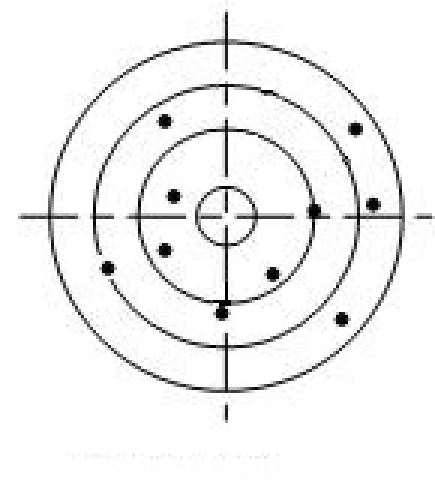
Scenario B: A dart thrower throws darts all over the dartboard, with no consistent pattern.