Triple Beam Balance Mastery
A Grade 12 science worksheet focusing on the principles, operation, and applications of the triple beam balance for accurate mass measurement.
Includes
Standards
Topics
Triple Beam Balance Mastery
Name:
Date:
Score:
Read each question carefully and provide thorough answers based on your understanding of the triple beam balance and its operation. Show all calculations where applicable.
1. What is the primary purpose of a triple beam balance in a laboratory setting?
Measuring liquid volume
Determining an object's density
Measuring the mass of an object
Calculating temperature changes
2. Before placing an object on the pan, what critical step must be performed to ensure accurate measurement?
Lubricating the beams
Zeroing the balance
Warming up the device
Calibrating with a known weight
3. The three beams on a triple beam balance are typically graduated in units of , , and .
4. When reading a triple beam balance, the final mass is determined by the readings from all three beams.
5. Describe the process of properly zeroing a triple beam balance. Why is this step crucial for obtaining accurate measurements?
6. An object's mass is measured using a triple beam balance. The riders are positioned as follows: 100g beam at 70g, 10g beam at 5g, and 1g beam at 0.7g. What is the total mass of the object?
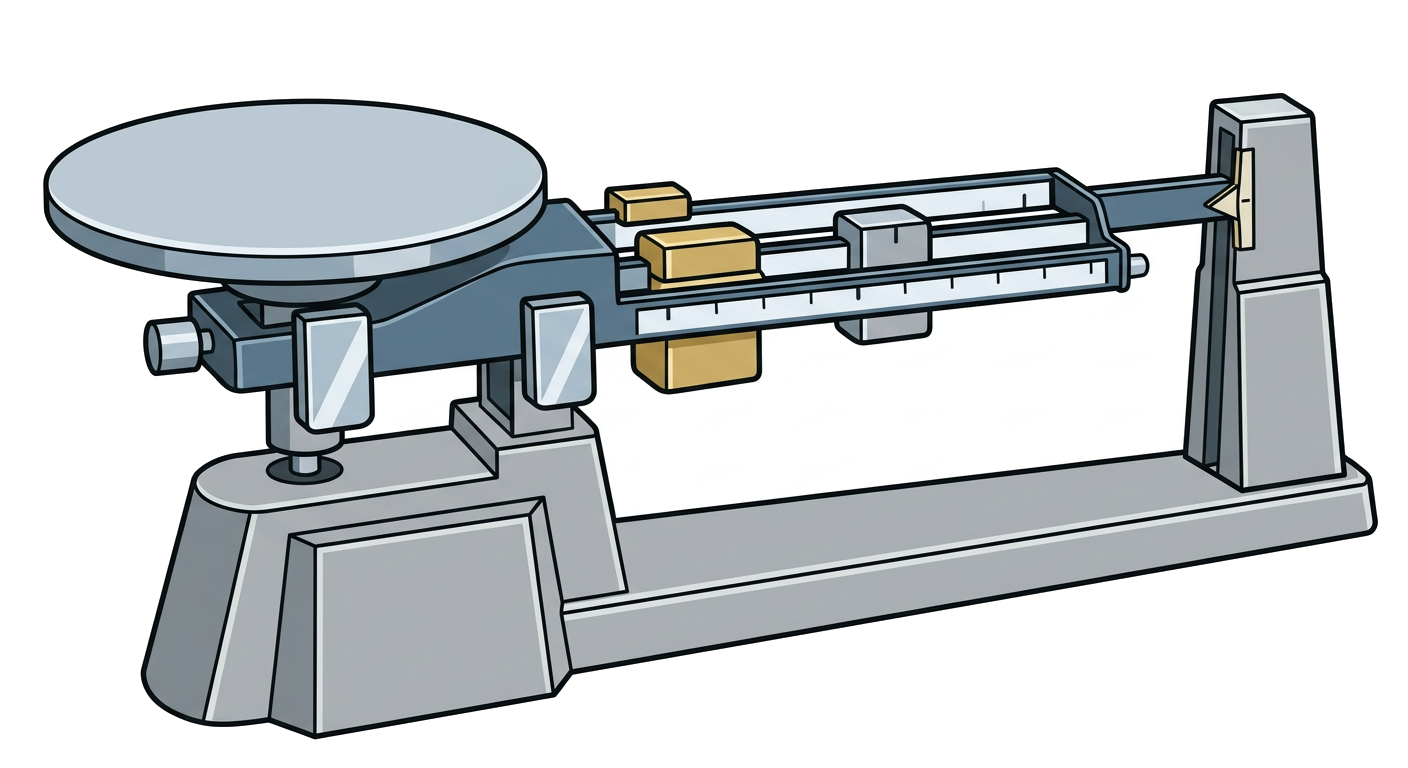
7. Observe the provided image of a triple beam balance. Identify and label the following parts: pan, riders, beams, and pointer.
8. A triple beam balance is generally more precise than a digital electronic balance.
True
False
9. If the pointer of a triple beam balance is above the zero mark when no object is on the pan, the balance is properly zeroed.
True
False
10. Discuss potential sources of error when using a triple beam balance and suggest methods to minimize these errors to ensure the highest possible accuracy in experimental measurements.