Workers' Rights: Foundations and Challenges
This worksheet explores the historical and contemporary aspects of workers' rights, including key legislation, labor movements, and ongoing challenges in the global economy.
Includes
Standards
Topics
Workers' Rights: Foundations and Challenges
Name:
Date:
Score:
Read each question carefully and provide thoughtful responses based on your knowledge of workers' rights, labor history, and civics. Some questions may require critical thinking and analysis.
1. Which of the following pieces of legislation established the federal minimum wage and overtime pay in the United States?
National Labor Relations Act (Wagner Act)
Fair Labor Standards Act (FLSA)
Occupational Safety and Health Act (OSHA)
Civil Rights Act of 1964
2. The primary goal of early labor unions was often to achieve:
Increased corporate profits
Better working conditions and wages
Elimination of all government regulation
Formation of monopolies
3. The Triangle Shirtwaist Factory fire in 1911 led to significant reforms in and laws.
4. Collective bargaining is the process by which employers and a group of employees, often represented by a , negotiate terms and conditions of employment.
5. The right to form and join trade unions is protected under international human rights law.
True
False
6. The gig economy has made it simpler to apply traditional workers' rights protections to all workers.
True
False
7. Briefly explain the concept of 'at-will employment' and its implications for workers' rights.
8. Discuss one significant challenge to workers' rights in the 21st century, such as automation or globalization.
Match each term with its correct description.
9. OSHA
a. Protects the right to organize unions
10. NLRA
b. Ensures safe and healthy working conditions
11. FLSA
c. Establishes minimum wage and overtime pay
The image below depicts a scene from the Great Depression, a period that significantly impacted labor conditions and the fight for workers' rights in the United States.
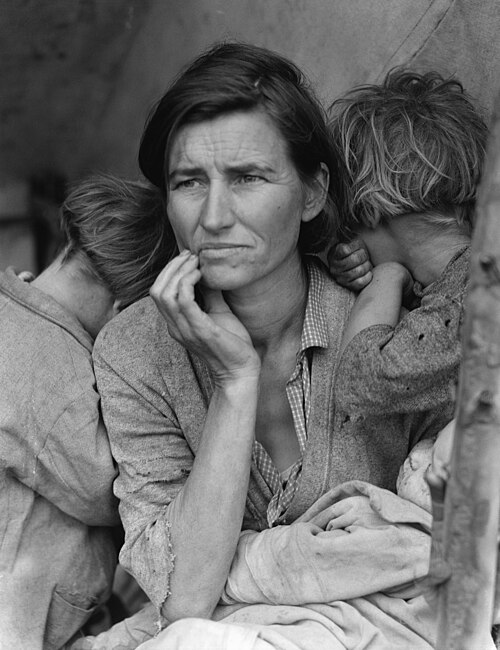
12. Based on your understanding of the Great Depression and the image provided, how did economic hardships during this era influence the demand for stronger workers' rights and the growth of labor unions?