Ocean Water Movements
Explore the forces driving ocean currents, waves, and tides, and their impact on global climate and ecosystems.
Includes
Standards
Topics
Ocean Water Movements
Name:
Date:
Score:
Read each question carefully and provide thoughtful answers based on your understanding of ocean water movements.
1. Which of the following is the primary driving force behind surface ocean currents?
Tidal forces from the moon
Prevailing winds
Density differences in water
Earth's magnetic field
2. What phenomenon is responsible for the deflection of ocean currents in the Northern and Southern Hemispheres?
Upwelling
Coriolis effect
El Niño
Thermohaline circulation
3. The global conveyor belt, driven by differences in water temperature and salinity, is also known as .
4. Waves are primarily caused by , transferring energy through the water.
5. The periodic rise and fall of sea level, known as , are mainly influenced by the gravitational pull of the Moon and the Sun.
6. Explain the difference between a deep-water wave and a shallow-water wave.
7. El Niño is a climate pattern that describes the unusual warming of surface waters in the eastern equatorial Pacific Ocean.
True
False
8. The Gulf Stream is a warm ocean current that significantly influences the climate of Western Europe.
True
False
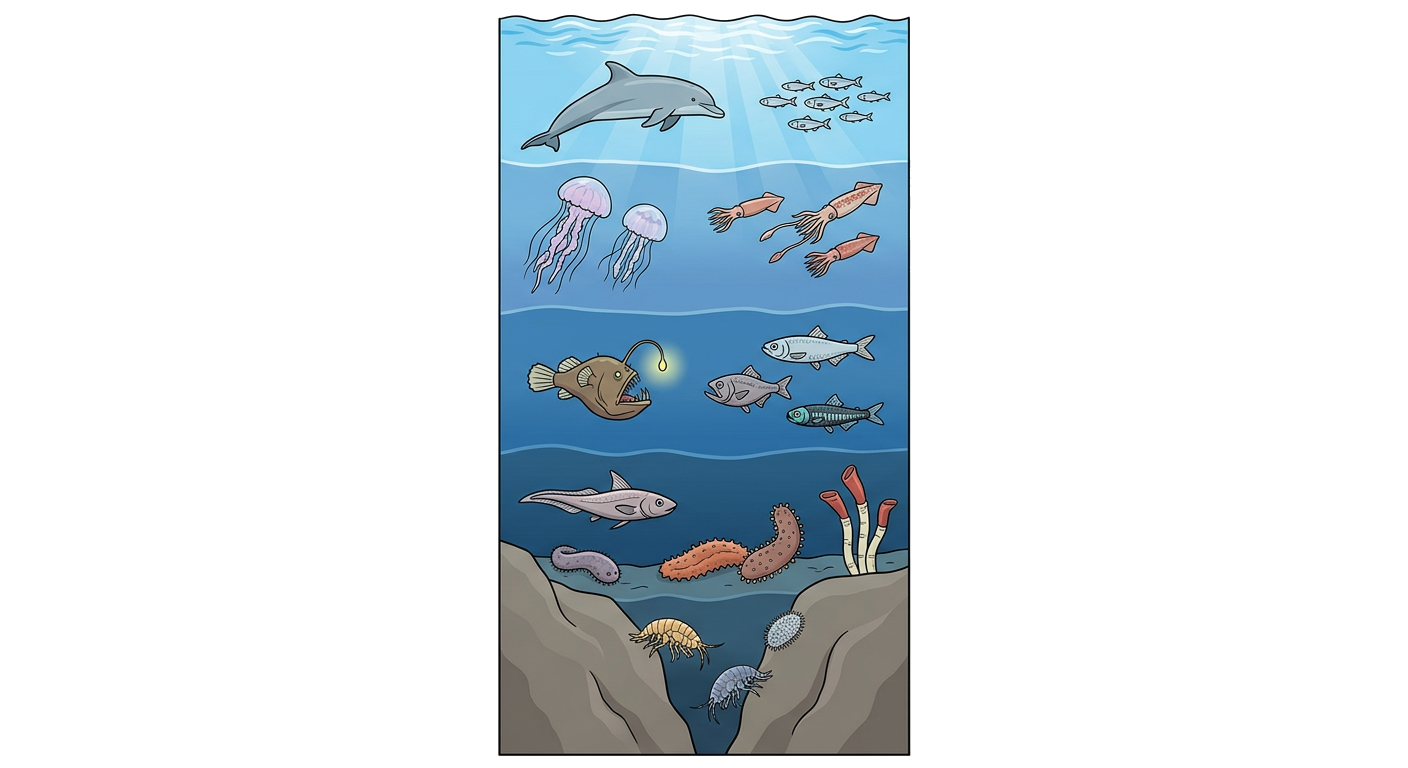
9. The diagram below illustrates different zones of the ocean. Based on the diagram and your knowledge, describe how ocean currents can transport marine organisms between these zones.
Match the term on the left with its correct definition on the right.
10. Thermohaline Circulation
a. The horizontal movement of water due to wind.
11. Gyre
b. A large system of circulating ocean currents.
12. Upwelling
c. The movement of cold, nutrient-rich water from the deep ocean to the surface.
13. Surface Current
d. Deep ocean current driven by differences in water density.
14. Discuss two significant ways in which ocean currents influence global climate patterns.