The Anaconda Plan: A Civil War Strategy
This worksheet explores the Anaconda Plan, a key Union strategy during the American Civil War, examining its objectives, implementation, and effectiveness.
Includes
Standards
Topics
The Anaconda Plan: A Civil War Strategy
Name:
Date:
Score:
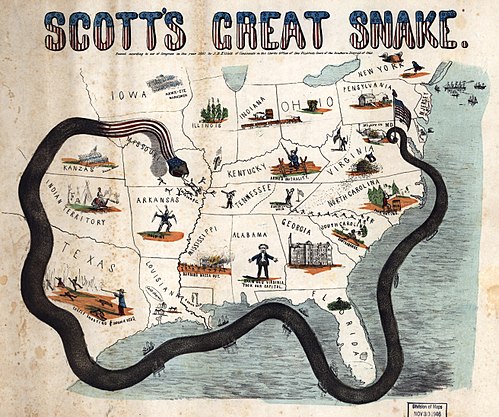
Read each question carefully and provide thoughtful, well-supported answers. Use the provided map to assist in answering questions about the Anaconda Plan's geographical scope.
The Anaconda Plan was a Union strategy developed early in the American Civil War by General Winfield Scott. It aimed to suppress the Confederacy by blockading Southern ports and controlling the Mississippi River, effectively 'strangling' the South economically and militarily. This plan was initially met with derision but ultimately formed the basis for the Union's winning strategy.
1. Who proposed the Anaconda Plan?
Ulysses S. Grant
Robert E. Lee
Winfield Scott
Abraham Lincoln
2. What were the two main components of the Anaconda Plan?
Naval blockades and direct assault on Richmond
Control of the Mississippi River and emancipation of slaves
Naval blockades and control of the Mississippi River
Guerilla warfare and foreign alliances
3. The Anaconda Plan was designed to effectively the Confederacy.
4. Control of the River was crucial to splitting the Confederacy in two.
5. Examine the map below. How did the geographical features of the Confederacy make the Anaconda Plan a viable strategy?
6. The Anaconda Plan was immediately embraced by all Union military leaders.
True
False
7. Discuss the long-term impact of the Anaconda Plan on the Confederate war effort, considering both its economic and military implications.
Related Worksheets
The Emancipation Proclamation: A Turning Point
This worksheet explores the historical context, content, and impact of the Emancipation Proclamation, a pivotal document in U.S. history.
The Roaring Twenties: A Deep Dive
This worksheet explores the social, economic, and political transformations of the Roaring Twenties in the United States, suitable for Grade 12 Social Studies.
The Progressive Era: Reforms and Impact
Explore the key reforms, figures, and lasting impact of the Progressive Era in U.S. History through a variety of question types.
Impeachment Process in the U.S. Government
Explore the impeachment process for high school students, covering its historical context, constitutional basis, and practical application in U.S. government.
Alphabet Agencies of the New Deal
Explore the key Alphabet Agencies created during Franklin D. Roosevelt's New Deal, their purposes, and their impact on American society and government.