The Great Debate: Federalists vs. Anti-Federalists
A Grade 12 social studies worksheet exploring the key arguments and figures in the Federalist and Anti-Federalist debates over the U.S. Constitution.
Includes
Standards
Topics
The Great Debate: Federalists vs. Anti-Federalists
Name:
Date:
Score:
Read each question carefully and answer to the best of your knowledge. This worksheet will test your understanding of the Federalist and Anti-Federalist arguments during the ratification of the U.S. Constitution.
1. Which of the following was a primary concern of the Anti-Federalists regarding the new Constitution?
The lack of a strong executive branch.
The potential for a tyrannical central government.
The absence of a national judiciary.
The inability to raise a national army.
2. Who was a prominent author of The Federalist Papers, arguing for the ratification of the Constitution?
Patrick Henry
George Mason
James Madison
Samuel Adams
1. The Anti-Federalists were generally in favor of a strong, centralized national government.
True
False
2. Federalist No. 10 primarily discusses the dangers of factions and how a large republic can control their effects.
True
False
1. The collection of essays written to persuade New Yorkers to ratify the Constitution is known as The Papers.
2. Anti-Federalists demanded a of Rights to protect individual liberties.
3. The primary author of the U.S. Constitution, and a key Federalist, was .
1. Briefly explain the main difference in the views of Federalists and Anti-Federalists regarding the power of the central government.
2. What was the purpose of The Federalist Papers? Name at least two of its authors.
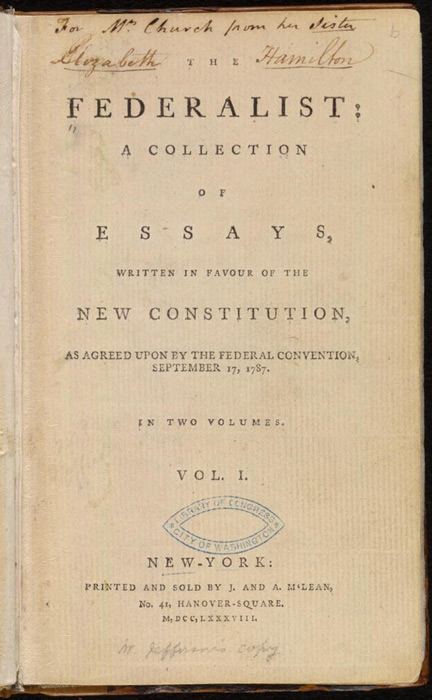
The image above shows the title page of the first edition of The Federalist, a collection of essays that played a crucial role in the debate over the U.S. Constitution. These essays were written under the pseudonym 'Publius'.
Match each individual or group with their primary stance during the Federalist Debate.
1. Alexander Hamilton
a. Anti-Federalist
2. Thomas Jefferson
b. Federalist
3. Advocates for states' rights
c. Generally aligned with Anti-Federalists
Related Worksheets
The Emancipation Proclamation: A Turning Point
This worksheet explores the historical context, content, and impact of the Emancipation Proclamation, a pivotal document in U.S. history.
The Roaring Twenties: A Deep Dive
This worksheet explores the social, economic, and political transformations of the Roaring Twenties in the United States, suitable for Grade 12 Social Studies.
The Progressive Era: Reforms and Impact
Explore the key reforms, figures, and lasting impact of the Progressive Era in U.S. History through a variety of question types.
Impeachment Process in the U.S. Government
Explore the impeachment process for high school students, covering its historical context, constitutional basis, and practical application in U.S. government.
Alphabet Agencies of the New Deal
Explore the key Alphabet Agencies created during Franklin D. Roosevelt's New Deal, their purposes, and their impact on American society and government.