Thurgood Marshall: A Legacy of Justice
This worksheet explores the life and impact of Thurgood Marshall, focusing on his contributions to civil rights and his tenure on the Supreme Court.
Includes
Standards
Topics
Thurgood Marshall: A Legacy of Justice
Name:
Date:
Score:
Read each question carefully and answer to the best of your ability. Use complete sentences for short answer questions.
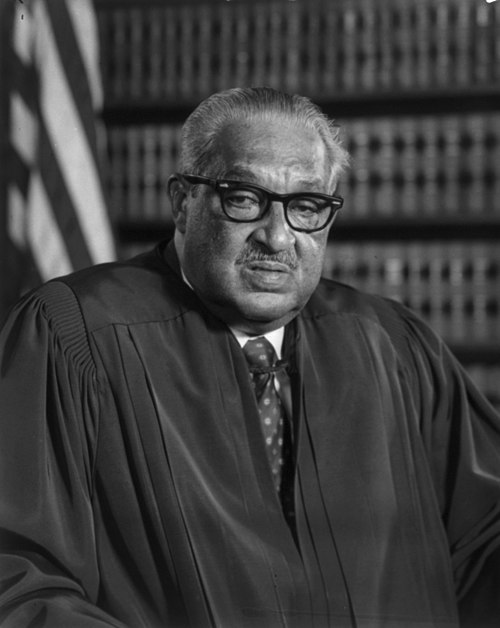
Thurgood Marshall was a pivotal figure in the American Civil Rights Movement and a groundbreaking justice on the Supreme Court. His legal strategies and judicial philosophy significantly shaped the course of American law and society.
1. Which landmark Supreme Court case, successfully argued by Thurgood Marshall, declared state-sponsored segregation in public schools unconstitutional?
Plessy v. Ferguson
Dred Scott v. Sandford
Brown v. Board of Education
Miranda v. Arizona
2. Before being appointed to the Supreme Court, Thurgood Marshall served as the chief counsel for which civil rights organization?
Southern Christian Leadership Conference (SCLC)
National Association for the Advancement of Colored People (NAACP)
Congress of Racial Equality (CORE)
Student Nonviolent Coordinating Committee (SNCC)
3. Thurgood Marshall was the first African American to serve as a Justice on the .
4. Marshall's legal strategy often focused on challenging the concept of "separate but equal" established by the case of .
5. Describe one significant contribution Thurgood Marshall made to the Civil Rights Movement before his appointment to the Supreme Court.
6. Explain the lasting impact of Thurgood Marshall's work on American society and legal precedent.
7. Thurgood Marshall primarily advocated for civil disobedience as a means to achieve racial equality.
True
False
8. Thurgood Marshall was appointed to the Supreme Court by President John F. Kennedy.
True
False