Exploring Bodies of Water
A worksheet for Grade 2 students to learn about different types of bodies of water.
Includes
Topics
Exploring Bodies of Water
Name:
Date:
Score:
Read each question carefully and answer to the best of your ability.
1. Which body of water is a large area of saltwater that covers most of the Earth?
River
Lake
Ocean
Pond
2. A small body of freshwater, usually smaller than a lake, is called a:
Ocean
Pond
River
Sea
3. A large natural stream of water flowing in a channel to the sea, a lake, or another stream is called a .
4. A large body of water surrounded by land is called a .
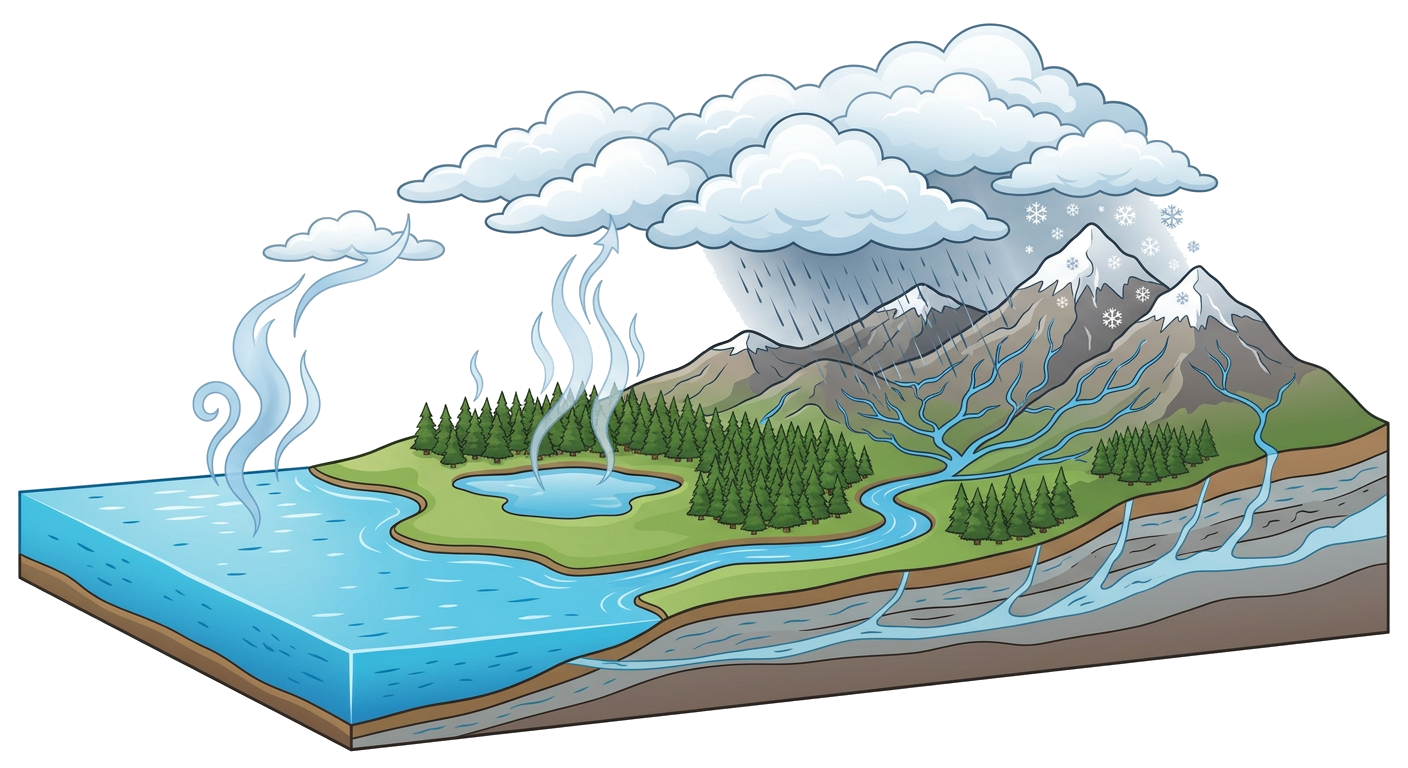
5. The water cycle is the journey water takes as it circulates from the land to the sky and back again. Look at the image below:
6. All bodies of water on Earth contain saltwater.
True
False
7. A river always flows into an ocean.
True
False
8. Name two different bodies of water you might see in your state.
Related Worksheets
My State Facts Worksheet
A Grade 2 Social Studies worksheet to learn basic facts about states, including capital cities, state birds, and flowers.
Political Maps Exploration
A Grade 2 Social Studies worksheet to introduce students to political maps, continents, and countries.
Map Components Worksheet
A worksheet for 2nd graders to learn about basic map components like compass rose, legend, and scale.
Landforms Exploration
A worksheet for Grade 2 students to learn about different types of landforms, their characteristics, and how to identify them.
Rocks and Minerals
Explore the fascinating world of rocks and minerals with this engaging worksheet designed for second graders. Learn about different types of rocks, their properties, and how they are used.
Capital Cities Explorer
Explore capital cities with this fun and educational worksheet for Grade 2 social studies.
Exploring Physical Maps
A worksheet for Grade 2 students to learn about physical maps, identifying landforms and water bodies.
Exploring State Maps
A Grade 2 Social Studies worksheet to help students learn about state maps, including identifying states, capitals, and understanding map symbols.