Cell Analogy Worksheet
Explore the functions of cell organelles by comparing them to parts of a city, factory, or house in this Grade 6 science worksheet.
Includes
Standards
Topics
Cell Analogy Worksheet
Name:
Date:
Score:
Cells are often compared to familiar places like a city or a factory to help us understand the functions of their organelles. Think about the job each organelle does and match it to a similar part of a city or factory.
Match each cell organelle with its best city analogy.
1. Nucleus
a. Power Plant
2. Mitochondria
b. City Hall/Main Office
3. Cell Membrane
c. Post Office/Delivery Service
4. Ribosomes
d. Factory Workers/Construction Site
5. Golgi Apparatus
e. City Border/Security Gate
6. Vacuole
f. Warehouse/Storage Unit
Look at the plant cell diagram and fill in the blanks with the correct organelle.
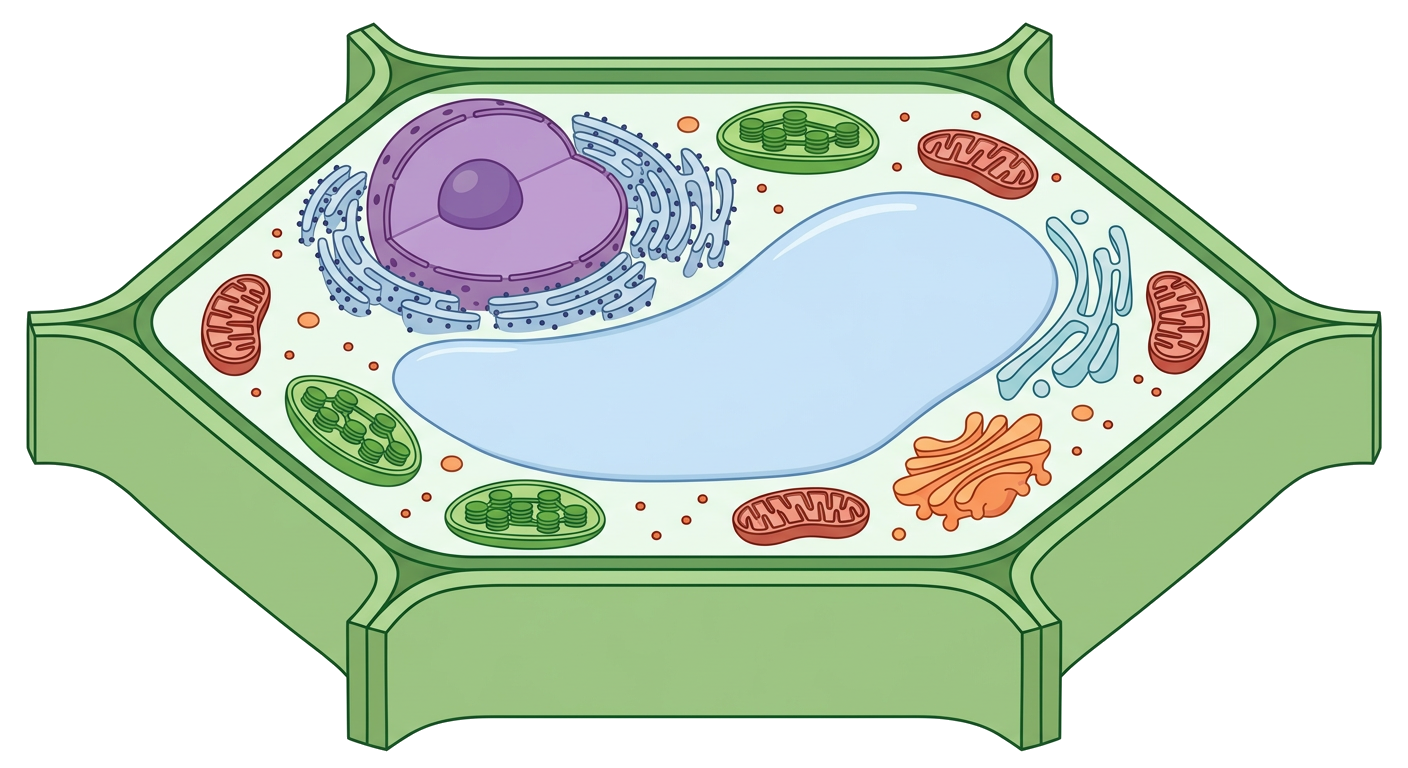
1. The rigid outer layer of a plant cell is the .
2. This organelle captures sunlight to make food: .
3. Plant cells have a large central for water storage.
1. Which organelle is responsible for generating most of the energy in an animal cell?
Nucleus
Mitochondria
Cell Wall
Chloroplast
2. Which part of an animal cell controls what enters and leaves the cell?
Cytoplasm
Ribosome
Cell Membrane
Endoplasmic Reticulum
1. Explain the main function of the nucleus and why it is often called the 'brain' of the cell. (Hint: Think about what the brain does in your body.)
2. Imagine a cell is like a house. Which part of the house would be the cell membrane and why?
Determine if the following statements are true or false.
1. The cell wall is found in both plant and animal cells.
True
False
2. Chloroplasts are responsible for photosynthesis in plant cells.
True
False
Use the words from the word bank to complete the sentences below about cell organelles.
1. The jelly-like substance filling the cell where organelles are suspended is the .
2. The is a network of membranes that processes and transports proteins and lipids.
3. Often called the 'recycling centers' of the cell, break down waste materials.
4. A large, fluid-filled sac that stores water, nutrients, and waste products in plant cells is the .
Related Worksheets
The Six Kingdoms of Life
Explore the characteristics and classification of organisms into the six kingdoms: Archaebacteria, Eubacteria, Protista, Fungi, Plantae, and Animalia.
Balance in Nature Worksheet
Explore the intricate balance within ecosystems, including food webs, predator-prey relationships, and the impact of environmental changes on natural balance.
Mitosis Worksheet
Explore the process of mitosis, including its stages and importance in cell division, for Grade 6 science students.
Fungi Fun Facts
Explore the amazing world of fungi with this interactive worksheet for Grade 6 science students.
Animal Cells: Exploring the Building Blocks of Life
This worksheet introduces 6th-grade students to the basic structure and functions of animal cells, including organelles like the nucleus, cytoplasm, and cell membrane.
The Excretory System
Explore the human excretory system with this worksheet for Grade 6 science students. Learn about the organs involved and their functions in waste removal.
Food Chain Fundamentals
Explore the basics of food chains, identifying producers, consumers, and decomposers, and understanding energy flow.
Grade 6 Circulatory System Worksheet
A worksheet for 6th graders to learn about the human circulatory system, including its components and functions.