Analyzing Substances: Grade 6 Science
This worksheet helps sixth-grade students understand the properties of matter, states of matter, and how to analyze different substances through observation and simple tests.
Includes
Standards
Topics
Analyzing Substances: Grade 6 Science
Name:
Date:
Score:
Read each question carefully and answer to the best of your ability. Show all your work for calculations.
1. Which of the following is a physical property of an object?
Its ability to burn
Its melting point
Its reactivity with acid
Its tendency to rust
2. What is the state of matter where particles are tightly packed and vibrate in fixed positions?
Liquid
Gas
Solid
Plasma
3. The amount of space an object takes up is called its .
4. A substance that dissolves in another substance is said to be .
5. All matter can exist in only one state: solid, liquid, or gas.
True
False
6. A chemical change always results in the formation of a new substance.
True
False
7. Describe two differences between a physical change and a chemical change.
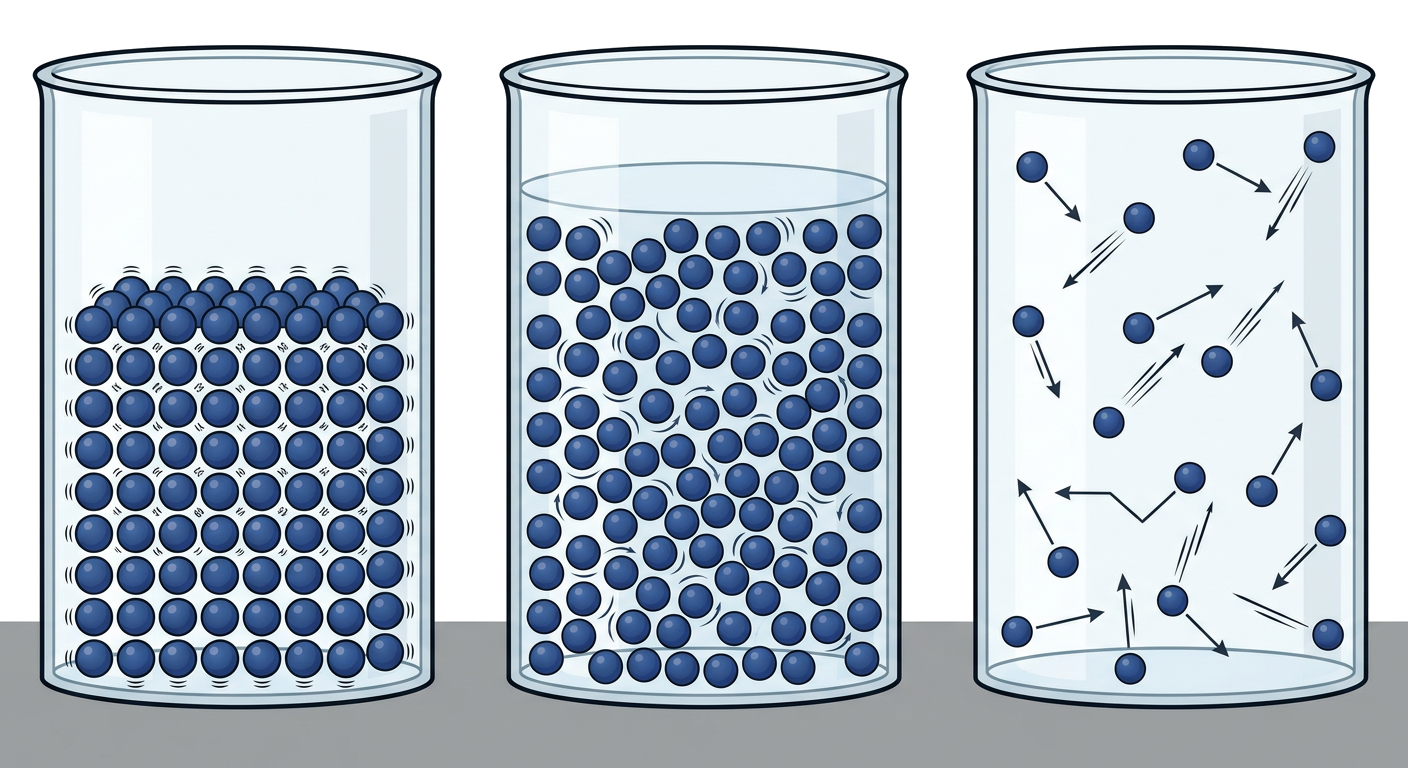
8. Observe the diagram below showing the particle view of different states of matter. Based on your knowledge, label each box with the correct state of matter (Solid, Liquid, or Gas).
Related Worksheets
Mixtures and Pure Substances
Explore the fundamental concepts of mixtures and pure substances with this engaging Grade 6 science worksheet.
Exploring Metalloids
A Grade 6 science worksheet introducing students to the properties and characteristics of metalloids, their position on the periodic table, and common examples.
Classification and Changes in Matter
Explore the classification of matter and differentiate between physical and chemical changes with this Grade 6 science worksheet.
Chemical Names and Formulas Basics
Explore the fundamentals of chemical names and formulas for common elements and compounds.
Classification of Matter Worksheet
Explore the different states of matter and their properties with this Grade 6 science worksheet.
Physical and Chemical Changes
Explore the differences between physical and chemical properties and changes with this Grade 6 science worksheet.
Understanding Phase Changes
Explore the different states of matter and the processes of phase change with this Grade 6 science worksheet.
Exploring Metals
A Grade 6 science worksheet focusing on the properties, uses, and classification of metals.