Introduction to Chemical Formulas
Explore the basics of chemical formulas, how they represent elements and compounds, and their importance in chemistry.
Includes
Standards
Topics
Introduction to Chemical Formulas
Name:
Date:
Score:
Read each question carefully and answer to the best of your ability. This worksheet will test your understanding of chemical formulas, elements, and compounds.
1. A chemical formula uses symbols to represent the present in a compound and the ratio of their atoms.
2. H₂O is the chemical formula for .
3. The small number written below and to the right of a chemical symbol is called a .
4. An is a substance that cannot be broken down into simpler substances by chemical means.
1. What does the '2' in H₂O represent?
Two oxygen atoms
Two hydrogen atoms
Two water molecules
The atomic number of hydrogen
2. Which of the following is an example of an element?
NaCl (Salt)
CO₂ (Carbon Dioxide)
O₂ (Oxygen)
C₆H₁₂O₆ (Glucose)
1. What is the difference between an element and a compound?
2. Write the chemical formula for carbon dioxide and explain what each part of the formula represents.
1. All compounds are made up of only one type of atom.
True
False
2. The chemical formula for salt is NaCl.
True
False
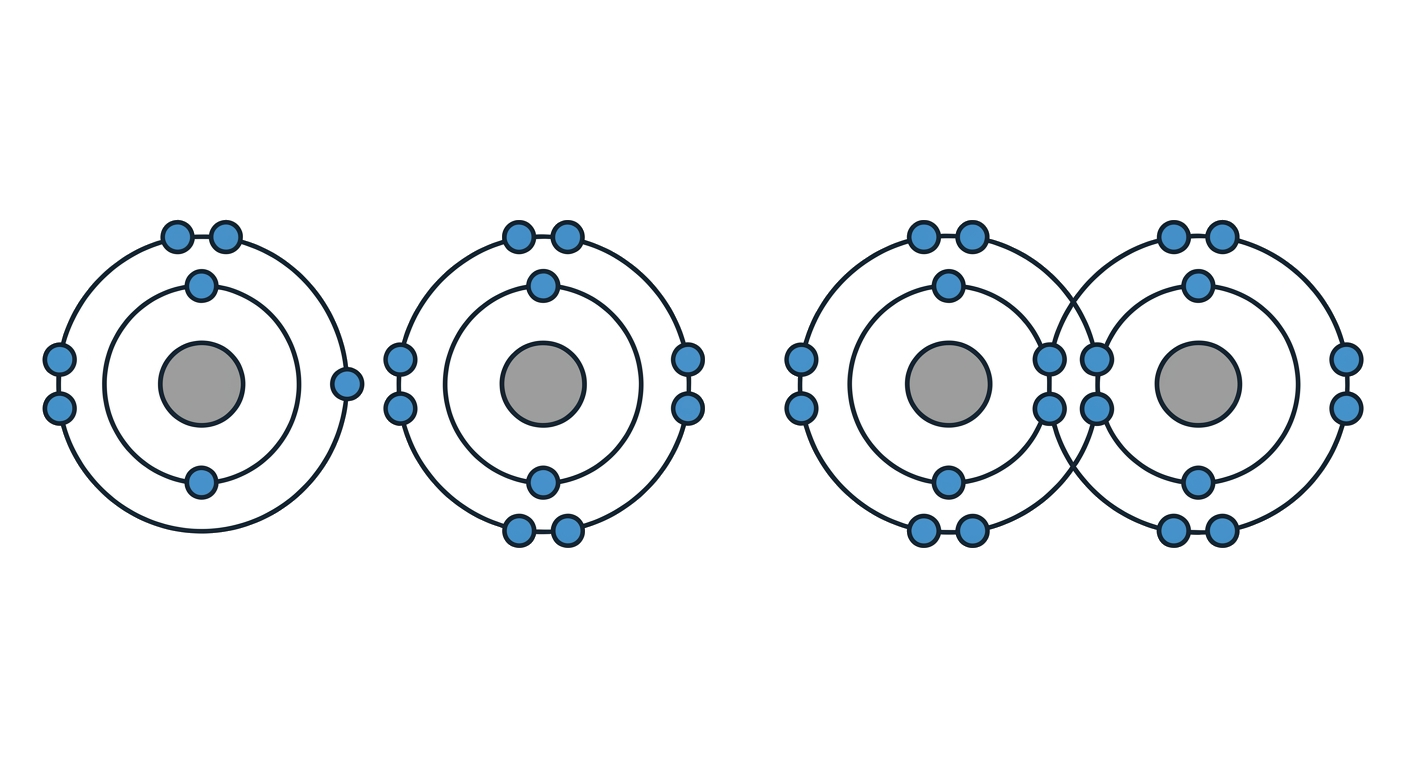
Observe the diagram below showing covalent bond formation. What elements are involved in this depiction and how many atoms of each are shown?
Use the words below to complete the sentences.
1. Water is a , formed when hydrogen and oxygen atoms chemically combine.
2. Gold (Au) is an example of an .
3. The number '2' in O₂ is a .
Related Worksheets
Mixtures and Pure Substances
Explore the fundamental concepts of mixtures and pure substances with this engaging Grade 6 science worksheet.
Exploring Metalloids
A Grade 6 science worksheet introducing students to the properties and characteristics of metalloids, their position on the periodic table, and common examples.
Classification and Changes in Matter
Explore the classification of matter and differentiate between physical and chemical changes with this Grade 6 science worksheet.
Chemical Names and Formulas Basics
Explore the fundamentals of chemical names and formulas for common elements and compounds.
Classification of Matter Worksheet
Explore the different states of matter and their properties with this Grade 6 science worksheet.
Physical and Chemical Changes
Explore the differences between physical and chemical properties and changes with this Grade 6 science worksheet.
Understanding Phase Changes
Explore the different states of matter and the processes of phase change with this Grade 6 science worksheet.
Exploring Metals
A Grade 6 science worksheet focusing on the properties, uses, and classification of metals.