Introduction to Ionic Bonding
This worksheet introduces 6th-grade students to the basic concepts of ionic bonding, including ions, electron transfer, and the formation of ionic compounds.
Includes
Standards
Topics
Introduction to Ionic Bonding
Name:
Date:
Score:
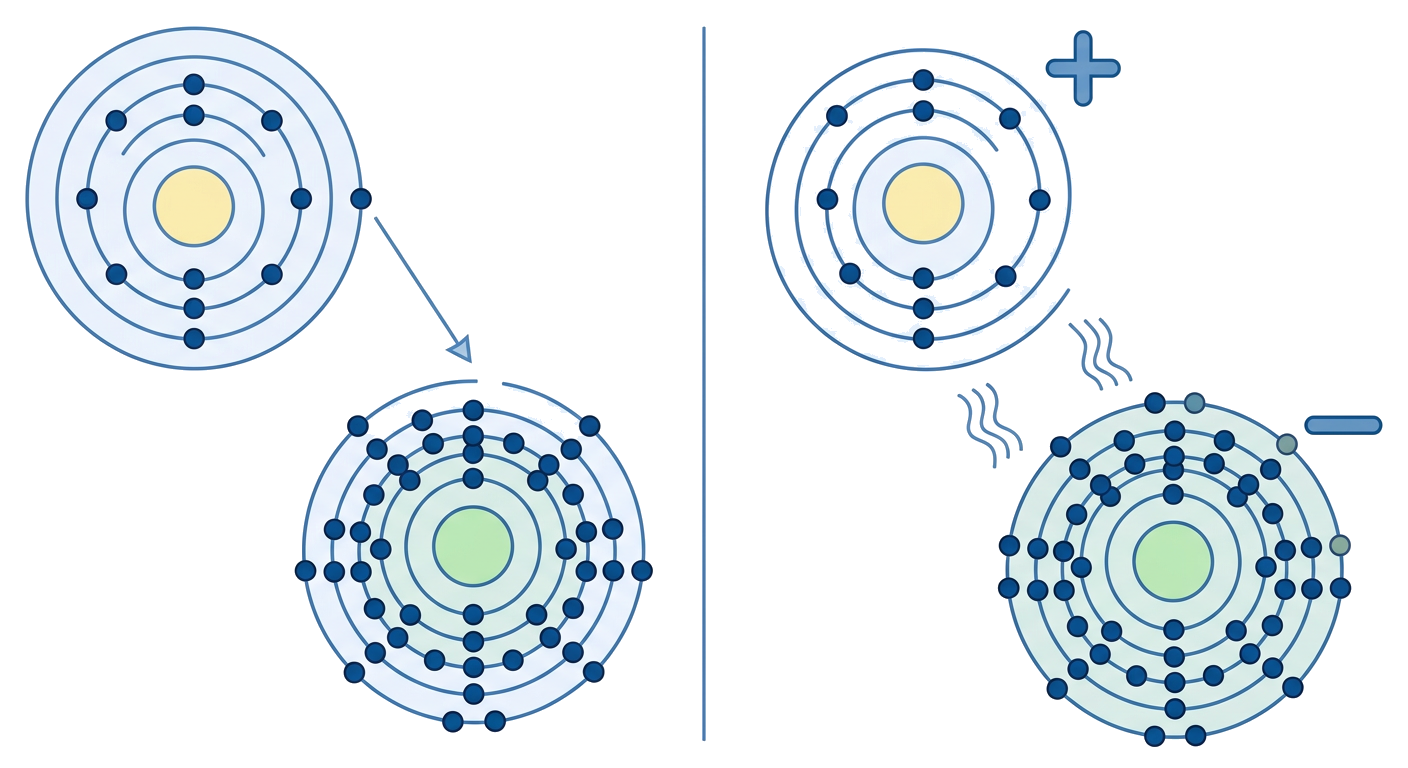
Read each question carefully and answer to the best of your ability. Use the provided image to help you understand ionic bonding.
Observe the diagram below showing the formation of an ionic bond.
1. What happens to electrons during the formation of an ionic bond?
They are shared between atoms.
They are transferred from one atom to another.
They are destroyed.
They remain in their original positions.
2. An atom that *loses* an electron becomes a(n):
anion
cation
neutral atom
molecule
3. An atom with a positive or negative charge is called an .
4. When atoms transfer electrons, they form an bond.
5. Ionic bonds typically form between two nonmetals.
True
False
6. Briefly explain the difference between a cation and an anion.
Use the words below to complete the sentences.
7. When a atom loses an , it becomes a ion.
8. When a atom gains an electron, it becomes a ion.
Related Worksheets
Mixtures and Pure Substances
Explore the fundamental concepts of mixtures and pure substances with this engaging Grade 6 science worksheet.
Exploring Metalloids
A Grade 6 science worksheet introducing students to the properties and characteristics of metalloids, their position on the periodic table, and common examples.
Classification and Changes in Matter
Explore the classification of matter and differentiate between physical and chemical changes with this Grade 6 science worksheet.
Chemical Names and Formulas Basics
Explore the fundamentals of chemical names and formulas for common elements and compounds.
Classification of Matter Worksheet
Explore the different states of matter and their properties with this Grade 6 science worksheet.
Physical and Chemical Changes
Explore the differences between physical and chemical properties and changes with this Grade 6 science worksheet.
Understanding Phase Changes
Explore the different states of matter and the processes of phase change with this Grade 6 science worksheet.
Exploring Metals
A Grade 6 science worksheet focusing on the properties, uses, and classification of metals.