Ionic Compounds Worksheet
Explore the basics of ionic compounds, including their formation, properties, and examples, suitable for Grade 6 science students.
Includes
Standards
Topics
Ionic Compounds Exploration
Name:
Date:
Score:
Read each question carefully and answer to the best of your ability. Some questions may require you to recall information about atoms and elements.
1. An ionic bond is formed when atoms or electrons.
2. Atoms that gain or lose electrons become charged particles called .
3. A positive ion is called a , and a negative ion is called an .
4. Table salt, also known as sodium chloride, is a common example of an compound.
5. Which type of elements typically form ionic bonds?
Two nonmetals
Two metals
A metal and a nonmetal
Noble gases
6. What holds an ionic compound together?
Sharing of electrons
Attraction between opposite charges
Repulsion between like charges
Metallic bonds
7. Ionic compounds are generally good conductors of electricity when dissolved in water.
True
False
8. Ionic compounds usually have low melting and boiling points.
True
False
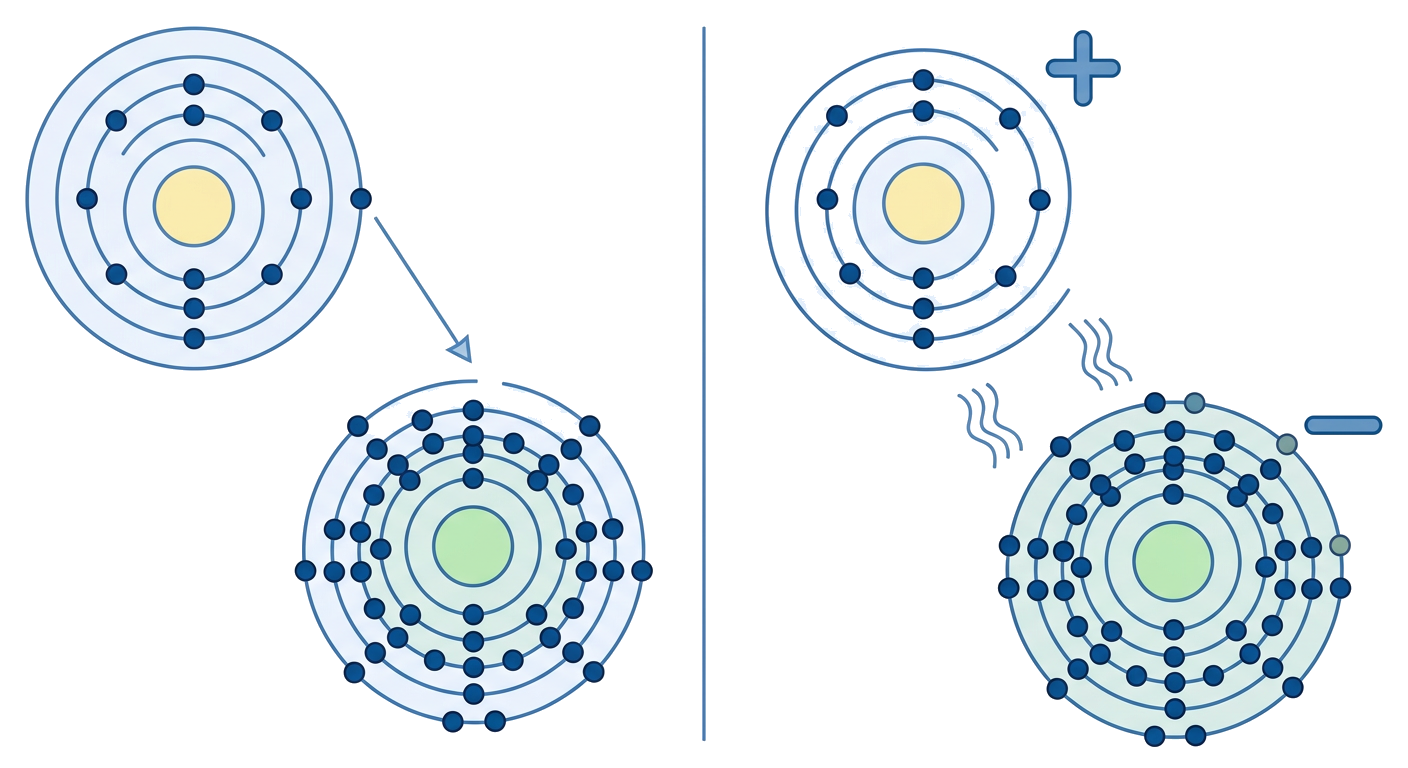
9. Describe how an ionic bond is formed between a metal and a nonmetal atom. Use the diagram below to help you explain.
Related Worksheets
Mixtures and Pure Substances
Explore the fundamental concepts of mixtures and pure substances with this engaging Grade 6 science worksheet.
Exploring Metalloids
A Grade 6 science worksheet introducing students to the properties and characteristics of metalloids, their position on the periodic table, and common examples.
Classification and Changes in Matter
Explore the classification of matter and differentiate between physical and chemical changes with this Grade 6 science worksheet.
Chemical Names and Formulas Basics
Explore the fundamentals of chemical names and formulas for common elements and compounds.
Classification of Matter Worksheet
Explore the different states of matter and their properties with this Grade 6 science worksheet.
Physical and Chemical Changes
Explore the differences between physical and chemical properties and changes with this Grade 6 science worksheet.
Understanding Phase Changes
Explore the different states of matter and the processes of phase change with this Grade 6 science worksheet.
Exploring Metals
A Grade 6 science worksheet focusing on the properties, uses, and classification of metals.