Naming Ionic Compounds
A Grade 6 science worksheet covering the basics of naming ionic compounds, including identifying cations and anions, and writing chemical formulas.
Includes
Standards
Topics
Naming Ionic Compounds
Name:
Date:
Score:
Read each question carefully and provide the best answer based on your knowledge of naming ionic compounds.
Ionic compounds are formed when atoms transfer electrons to achieve a stable electron configuration, resulting in charged particles called ions. These oppositely charged ions are attracted to each other, forming an ionic bond. We use specific rules to name these compounds.
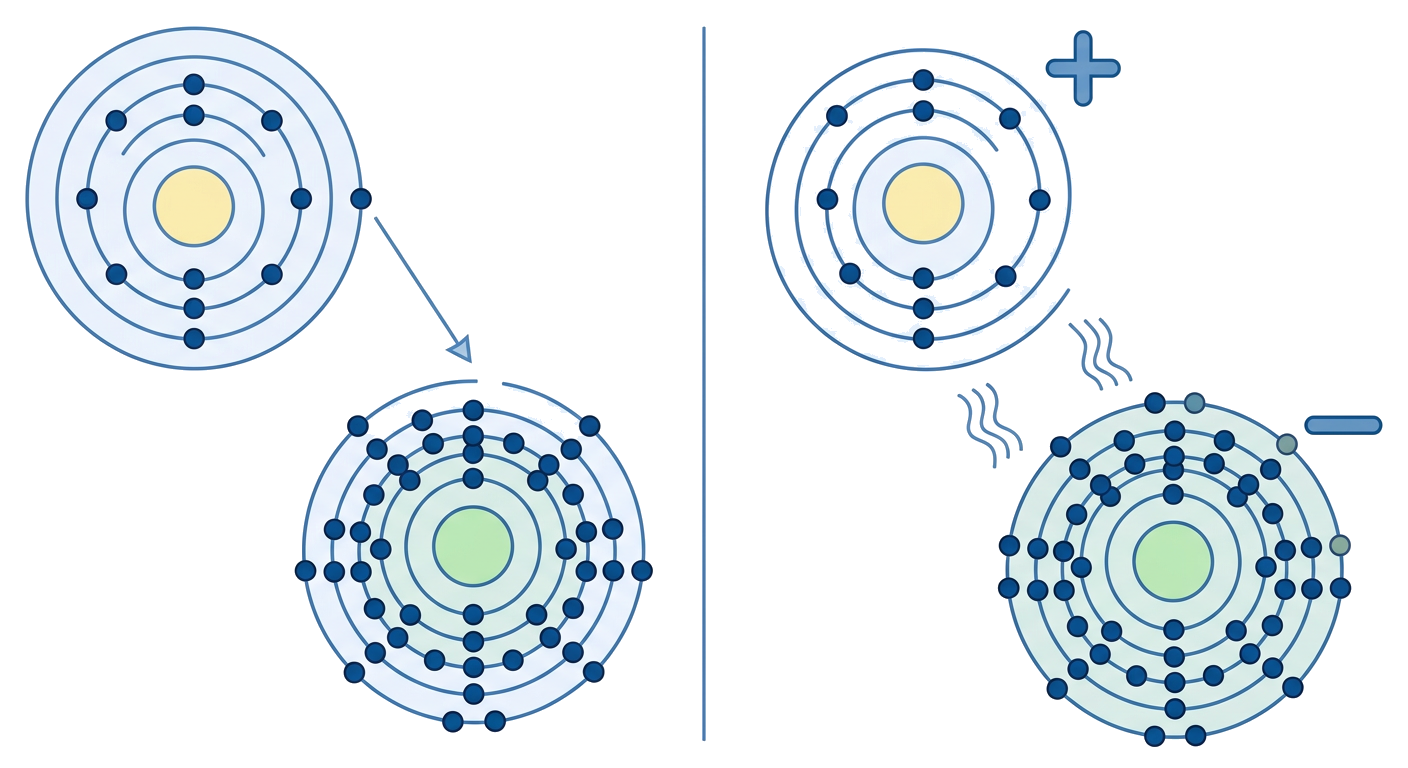
1. What type of bond is formed when electrons are transferred between atoms?
Covalent bond
Metallic bond
Ionic bond
Hydrogen bond
2. In an ionic compound, the metal atom typically forms a ion.
Negative
Positive
Neutral
Both positive and negative
3. The positive ion in an ionic compound is called a .
4. The negative ion in an ionic compound is called an .
5. When naming ionic compounds, the metal is named and the nonmetal ending is changed to .
6. Explain in your own words why ionic compounds are formed.
Match the chemical formula with its correct name.
7. NaCl
a. Calcium Chloride
8. MgO
b. Sodium Chloride
9. CaCl₂
c. Magnesium Oxide
10. In the compound potassium iodide (KI), potassium is the anion.
True
False
Related Worksheets
Mixtures and Pure Substances
Explore the fundamental concepts of mixtures and pure substances with this engaging Grade 6 science worksheet.
Exploring Metalloids
A Grade 6 science worksheet introducing students to the properties and characteristics of metalloids, their position on the periodic table, and common examples.
Classification and Changes in Matter
Explore the classification of matter and differentiate between physical and chemical changes with this Grade 6 science worksheet.
Chemical Names and Formulas Basics
Explore the fundamentals of chemical names and formulas for common elements and compounds.
Classification of Matter Worksheet
Explore the different states of matter and their properties with this Grade 6 science worksheet.
Physical and Chemical Changes
Explore the differences between physical and chemical properties and changes with this Grade 6 science worksheet.
Understanding Phase Changes
Explore the different states of matter and the processes of phase change with this Grade 6 science worksheet.
Exploring Metals
A Grade 6 science worksheet focusing on the properties, uses, and classification of metals.