Understanding the pH Scale
A worksheet for 6th graders to learn about the pH scale, acids, bases, and neutral substances.
Includes
Standards
Topics
Understanding the pH Scale
Name:
Date:
Score:
Read each question carefully and answer to the best of your ability. Use the provided pH scale diagram to help you.
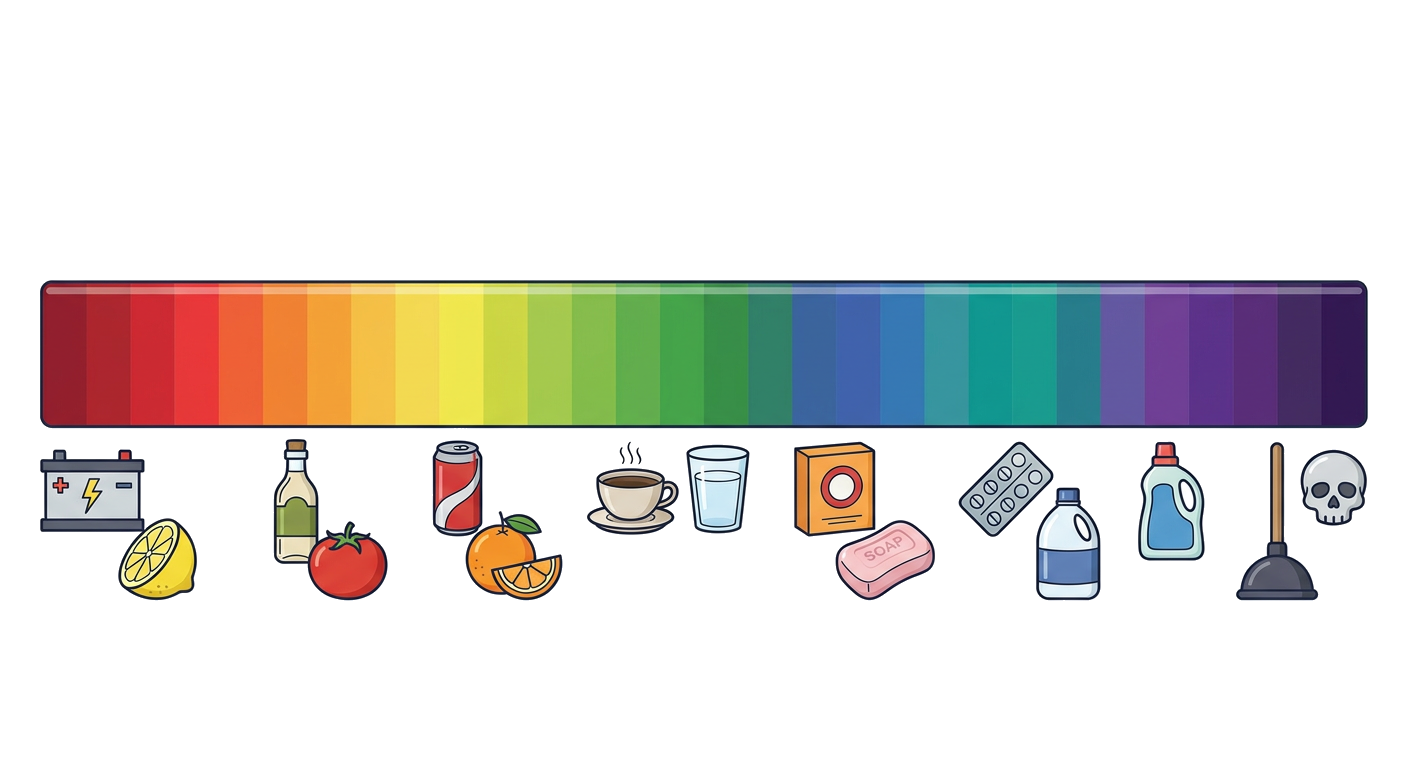
The pH scale ranges from 0 to 14. Values below 7 are acidic, 7 is neutral, and values above 7 are basic (alkaline).
1. What pH value indicates a neutral substance?
0
3
7
14
2. Which of the following is most likely an acid?
Bleach (pH 13)
Pure Water (pH 7)
Lemon Juice (pH 2)
Baking Soda (pH 9)
3. A substance with a pH of 10 is considered to be a(n) .
4. The pH scale measures how or a substance is.
5. A pH of 1 is more acidic than a pH of 6.
True
False
6. Bases have a sour taste and react with metals.
True
False
7. Give an example of an everyday acidic substance and an everyday basic substance.
Related Worksheets
Mixtures and Pure Substances
Explore the fundamental concepts of mixtures and pure substances with this engaging Grade 6 science worksheet.
Exploring Metalloids
A Grade 6 science worksheet introducing students to the properties and characteristics of metalloids, their position on the periodic table, and common examples.
Classification and Changes in Matter
Explore the classification of matter and differentiate between physical and chemical changes with this Grade 6 science worksheet.
Chemical Names and Formulas Basics
Explore the fundamentals of chemical names and formulas for common elements and compounds.
Classification of Matter Worksheet
Explore the different states of matter and their properties with this Grade 6 science worksheet.
Physical and Chemical Changes
Explore the differences between physical and chemical properties and changes with this Grade 6 science worksheet.
Understanding Phase Changes
Explore the different states of matter and the processes of phase change with this Grade 6 science worksheet.
Exploring Metals
A Grade 6 science worksheet focusing on the properties, uses, and classification of metals.