Relative Mass Exploration
Explore the concept of relative mass and how it applies to everyday objects and scientific measurements.
Includes
Standards
Topics
Relative Mass Exploration
Name:
Date:
Score:
Read each question carefully and answer to the best of your ability. This worksheet will help you understand the concept of relative mass.
1. Mass is a measure of the amount of in an object.
2. We use a or a balance scale to measure mass.
3. The standard unit for mass in the metric system is the .
1. Which of the following best describes 'relative mass'?
The exact mass of an object in kilograms.
Comparing the mass of one object to another object.
How heavy an object feels when you lift it.
The volume of an object.
1. Imagine you have a large feather and a small rock. Which one do you think has a greater mass? Explain your reasoning.
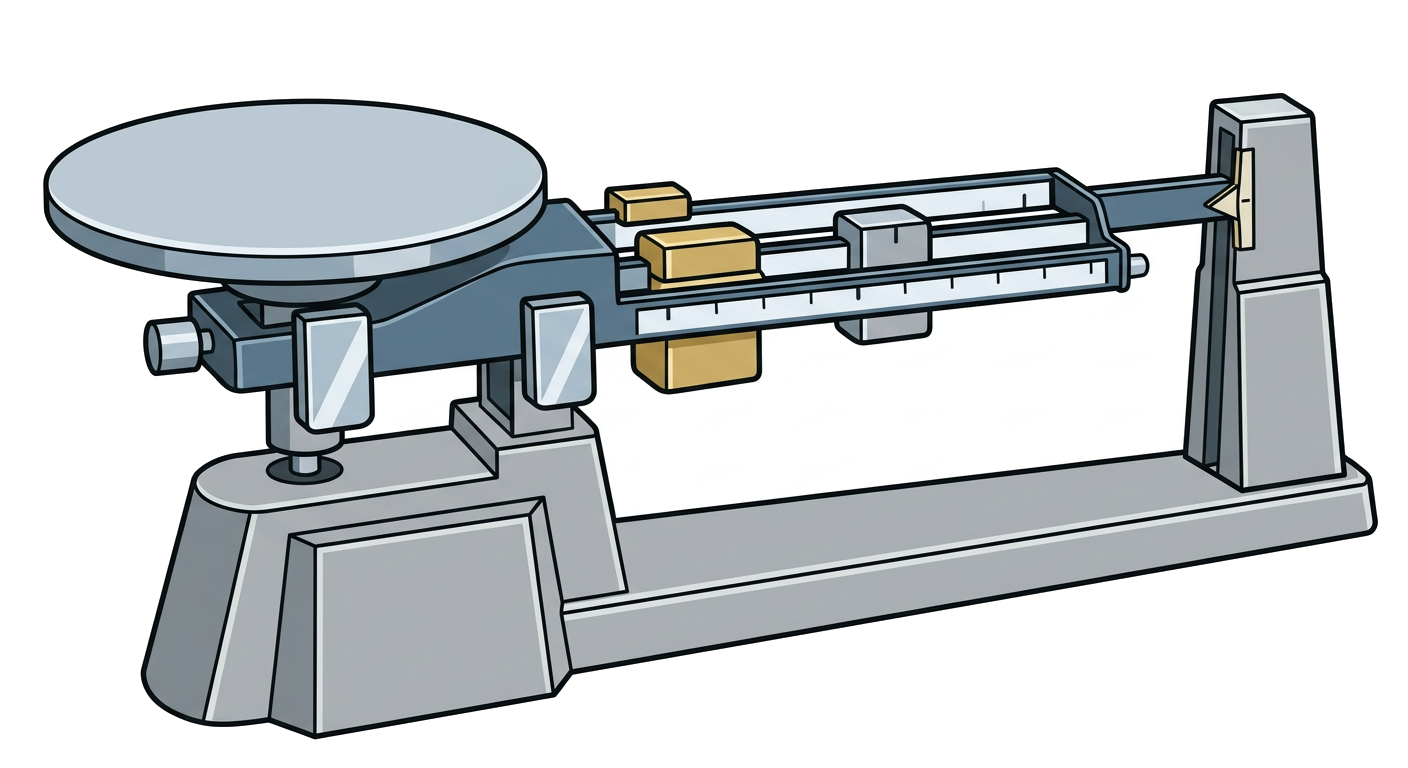
2. The image shows a triple beam balance. If you place an apple on one pan and a known mass of 100g on the other, and the balance tips towards the apple, what does this tell you about the apple's mass relative to 100g?
1. Relative mass can only be measured using very expensive scientific equipment.
True
False
2. If object A has a relative mass of 2 compared to object B, it means object A is twice as heavy as object B.
True
False
1. Why is understanding relative mass important in science?
Related Worksheets
Mixtures and Pure Substances
Explore the fundamental concepts of mixtures and pure substances with this engaging Grade 6 science worksheet.
Exploring Metalloids
A Grade 6 science worksheet introducing students to the properties and characteristics of metalloids, their position on the periodic table, and common examples.
Classification and Changes in Matter
Explore the classification of matter and differentiate between physical and chemical changes with this Grade 6 science worksheet.
Chemical Names and Formulas Basics
Explore the fundamentals of chemical names and formulas for common elements and compounds.
Classification of Matter Worksheet
Explore the different states of matter and their properties with this Grade 6 science worksheet.
Physical and Chemical Changes
Explore the differences between physical and chemical properties and changes with this Grade 6 science worksheet.
Understanding Phase Changes
Explore the different states of matter and the processes of phase change with this Grade 6 science worksheet.
Exploring Metals
A Grade 6 science worksheet focusing on the properties, uses, and classification of metals.