States of Matter Worksheet
Explore the three main states of matter: solid, liquid, and gas, and understand their properties and transitions.
Includes
Standards
Topics
States of Matter
Name:
Date:
Score:
Read each question carefully and answer to the best of your ability.
1. Which state of matter has a definite shape and a definite volume?
Liquid
Gas
Solid
Plasma
2. What happens to water when it reaches its boiling point?
It freezes
It evaporates into a gas
It becomes a solid
It condenses into a liquid
3. The process of a liquid turning into a gas is called .
4. When a gas turns into a liquid, it is called .
5. Solids have particles that are packed very together.
6. Gases have a definite volume but no definite shape.
True
False
7. Liquids take the shape of their container.
True
False
8. Describe the movement of particles in a solid, a liquid, and a gas.
9. Give an example of a substance that can exist in all three states of matter and explain how.
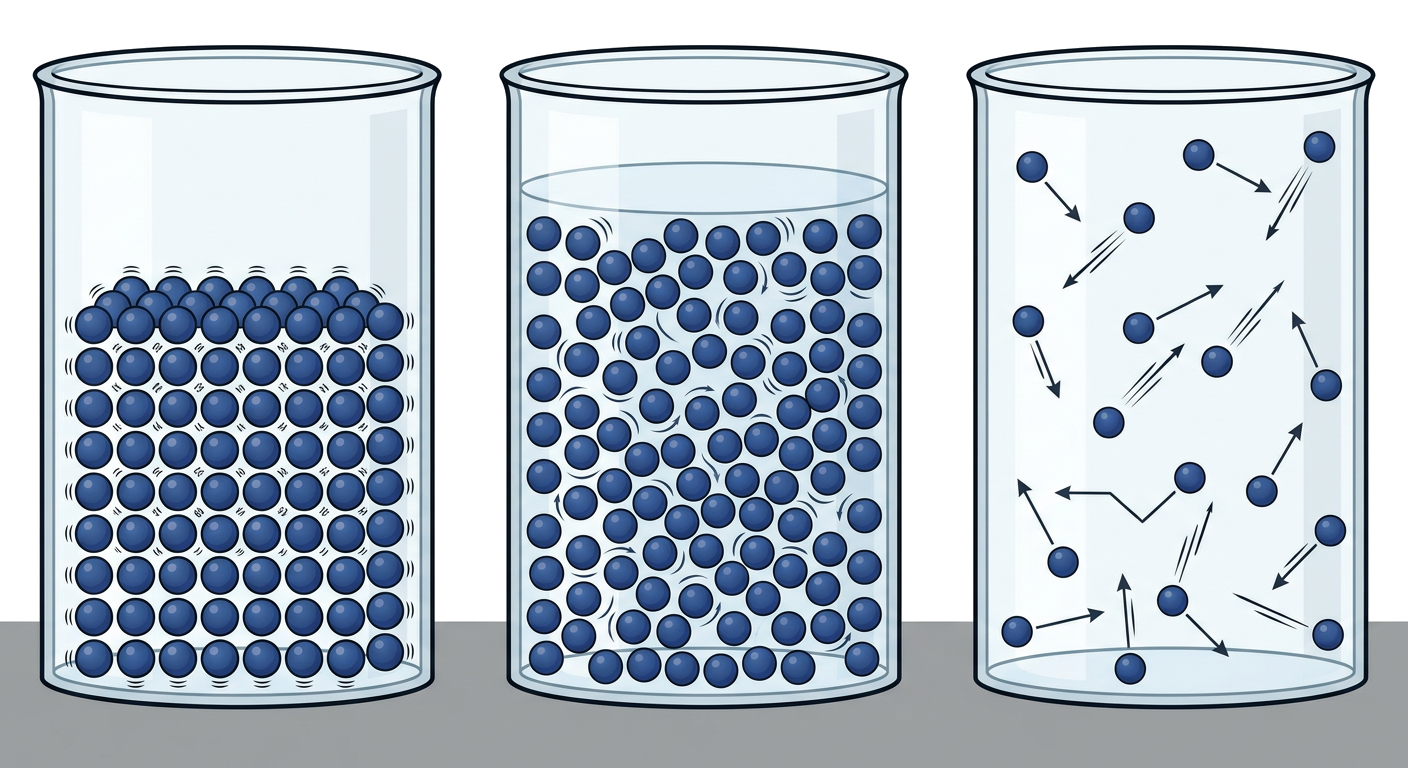
10. Observe the diagram below showing the particle arrangement in different states of matter. Label each box with the correct state of matter (Solid, Liquid, or Gas).
Related Worksheets
Mixtures and Pure Substances
Explore the fundamental concepts of mixtures and pure substances with this engaging Grade 6 science worksheet.
Exploring Metalloids
A Grade 6 science worksheet introducing students to the properties and characteristics of metalloids, their position on the periodic table, and common examples.
Classification and Changes in Matter
Explore the classification of matter and differentiate between physical and chemical changes with this Grade 6 science worksheet.
Chemical Names and Formulas Basics
Explore the fundamentals of chemical names and formulas for common elements and compounds.
Classification of Matter Worksheet
Explore the different states of matter and their properties with this Grade 6 science worksheet.
Physical and Chemical Changes
Explore the differences between physical and chemical properties and changes with this Grade 6 science worksheet.
Understanding Phase Changes
Explore the different states of matter and the processes of phase change with this Grade 6 science worksheet.
Exploring Metals
A Grade 6 science worksheet focusing on the properties, uses, and classification of metals.