Law of Superposition Worksheet
Explore the Law of Superposition, basic principles of stratigraphy, and how it helps us understand Earth's history through rock layers for Grade 6 science.
Includes
Standards
Topics
Law of Superposition Worksheet
Name:
Date:
Score:
Read each question carefully and answer to the best of your ability. Refer to the diagram of rock layers as needed.
The Law of Superposition states that in undisturbed rock layers, the oldest layers are at the bottom and the youngest layers are at the top.
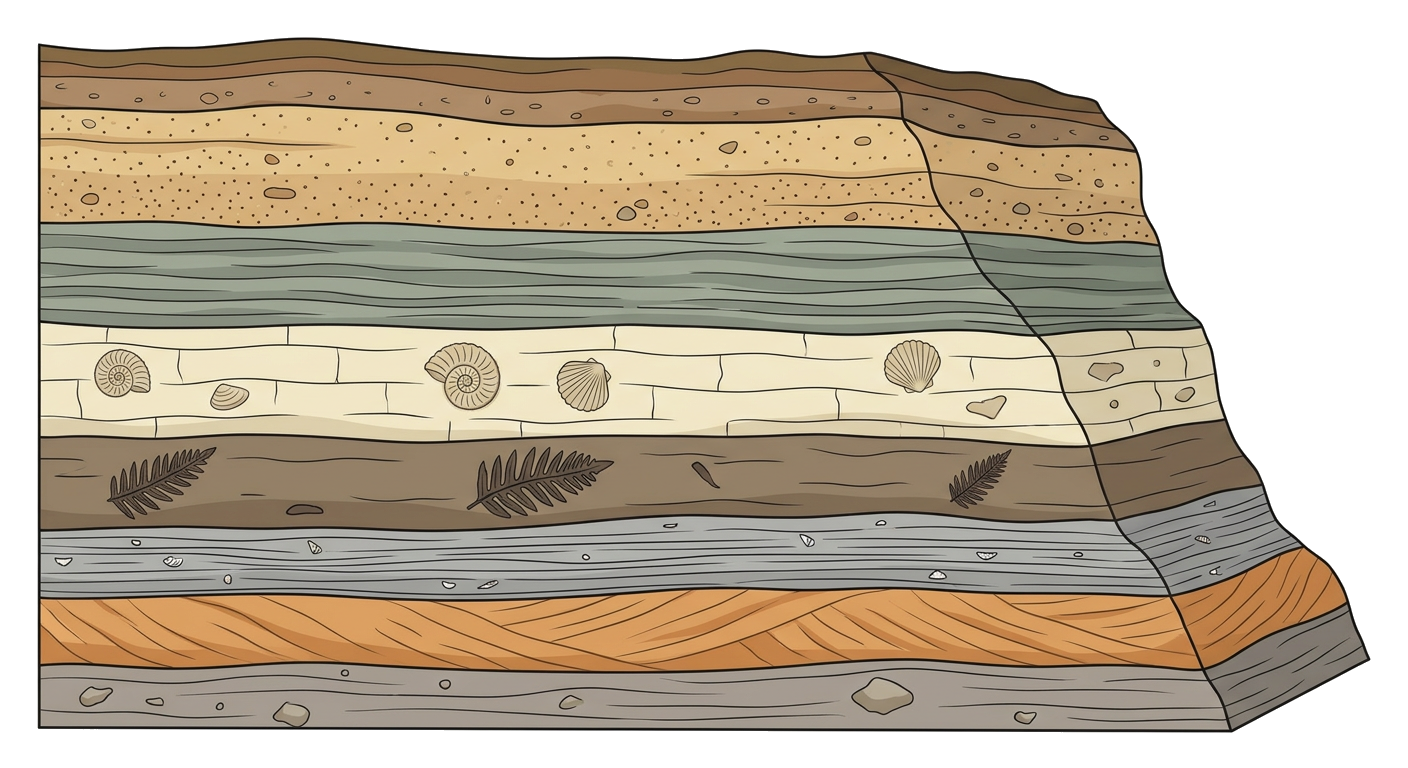
1. According to the Law of Superposition, which rock layer in the diagram above is the oldest?
2. Which rock layer is the youngest?
3. What does 'undisturbed' mean when talking about rock layers?
The layers have been moved by humans.
The layers have not been folded, faulted, or overturned.
The layers are all made of the same material.
The layers are very thin.
4. Why is the Law of Superposition important to geologists?
It helps them predict the weather.
It helps them understand the order of events in Earth's history.
It tells them how much water is in the ocean.
It explains how volcanoes erupt.
5. The Law of Superposition applies to all rock layers, even if they have been overturned.
True
False
6. Fossils found in lower rock layers are generally older than fossils found in upper rock layers.
True
False
7. The Law of Superposition helps us determine the age of rock layers.
8. Geologists use the Law of Superposition to reconstruct Earth's over millions of years.
9. Imagine you are digging a hole and find several distinct layers of soil and rock. How would you use the Law of Superposition to determine the relative ages of these layers?
Related Worksheets
Earth's Spin and Orbit
Explore the concepts of Earth's rotation and revolution, their causes, and their effects on day/night cycles and seasons.
Planets of Our Solar System
Explore the planets in our solar system with this interactive worksheet, covering key characteristics and facts.
Moon Phases Worksheet
Explore the different phases of the Moon and understand the science behind them with this Grade 6 worksheet.
Weather and Climate Worksheet
Explore the fundamentals of weather and climate, including the water cycle, atmospheric conditions, and factors influencing climate patterns.
Earthquakes and Volcanoes
Explore the forces that shape our planet with this Grade 6 science worksheet on earthquakes and volcanoes, covering their causes, effects, and related terminology.
The Carbon Cycle
An educational worksheet for 6th graders to learn about the carbon cycle, its components, and its importance in Earth's systems.
Land and Sea Breeze Worksheet
Explore the concepts of land breeze and sea breeze, understanding their causes and effects on coastal weather patterns.
Earth's Systems Worksheet
Explore the interconnected systems of Earth: atmosphere, hydrosphere, geosphere, and biosphere.