Locating Earthquakes
This worksheet helps sixth-grade students understand how earthquakes are located using seismic waves and seismographs.
Includes
Standards
Topics
Locating Earthquakes
Name:
Date:
Score:
Read each question carefully and answer to the best of your ability. Use complete sentences for short answer questions.
1. What are the two main types of seismic waves used to locate earthquakes?
Sound waves and light waves
P-waves and S-waves
Ocean waves and radio waves
Heat waves and magnetic waves
2. Which type of seismic wave arrives first at a seismograph station?
S-wave
P-wave
Surface wave
Tsunami wave
3. A tool used to detect and record seismic waves is called a .
4. The point on Earth's surface directly above where an earthquake originates is called the .
5. Scientists use data from at least seismograph stations to locate an earthquake's epicenter.
6. Explain how the difference in arrival times between P-waves and S-waves helps scientists determine the distance to an earthquake's epicenter.
7. S-waves can travel through both solids and liquids.
True
False
8. The focus of an earthquake is always on the Earth's surface.
True
False
9. Use the diagram below to answer the following questions.
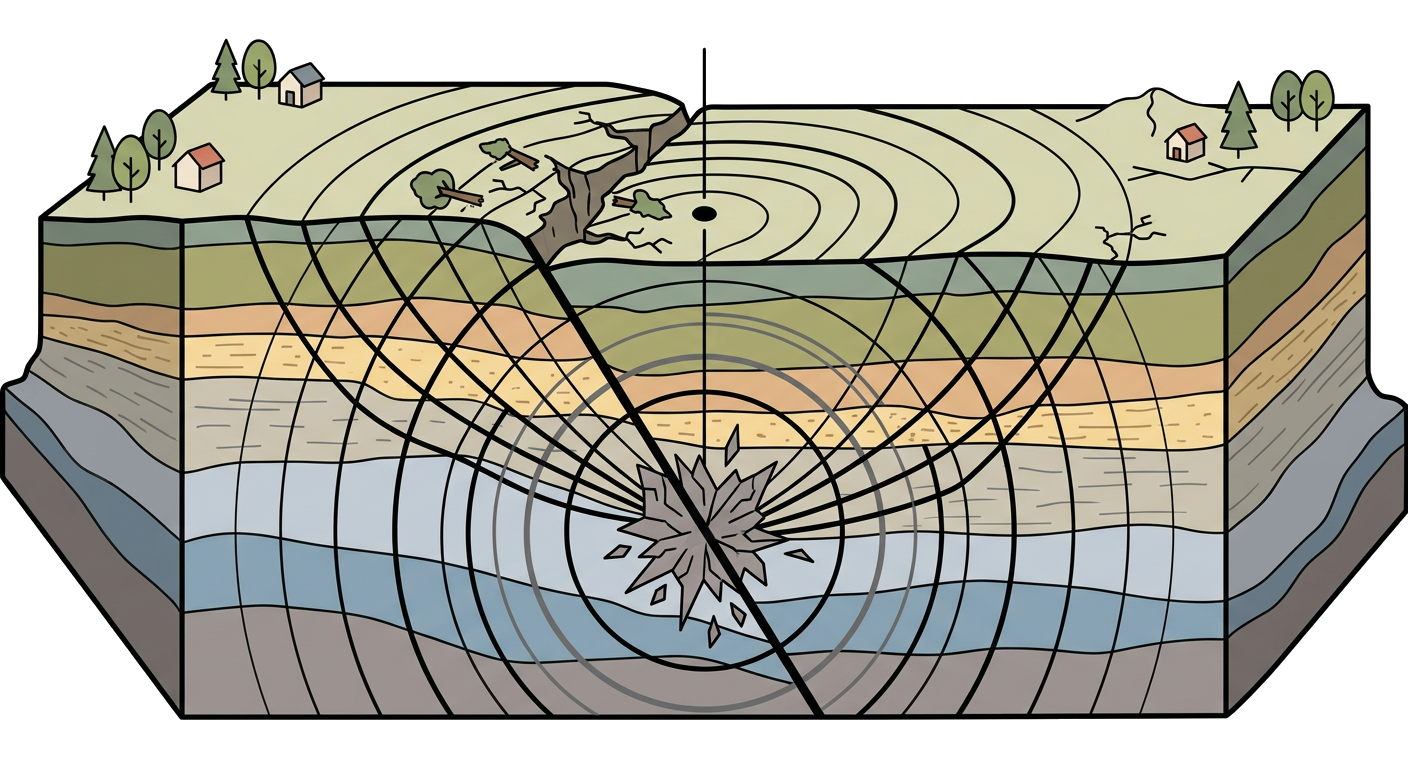
a) Label the 'epicenter' and 'focus' on the diagram.
b) Which type of seismic wave travels in a compressional motion (push and pull)?
Related Worksheets
Celestial Sphere Exploration
Explore the concept of the celestial sphere, its components, and how it helps us understand the movement of celestial objects.
Earth's Spin and Orbit
Explore the concepts of Earth's rotation and revolution, their causes, and their effects on day/night cycles and seasons.
Plate Tectonics Exploration
An introductory worksheet on plate tectonics for 6th graders, covering plate boundaries, features, and evidence.
Exploring Earth's Crust
A Grade 6 science worksheet covering the layers of the Earth, focusing on the crust, its composition, and characteristics.
Planets of Our Solar System
Explore the planets in our solar system with this interactive worksheet, covering key characteristics and facts.
Erosion Exploration
This worksheet explores the concepts of erosion, its causes, effects, and different types, suitable for 6th-grade science students.
The Nitrogen Cycle
An educational worksheet for 6th graders to learn about the nitrogen cycle, its stages, and its importance to living organisms.
Exploring Sedimentary Rocks
This worksheet introduces 6th-grade students to sedimentary rocks, their formation, characteristics, and common types through various question formats.