Introduction to Pedigrees
Explore the basics of pedigree charts, how to read them, and what they represent in genetics for Grade 6 science.
Includes
Standards
Topics
Introduction to Pedigrees
Name:
Date:
Score:
Read each question carefully and answer to the best of your ability. Refer to the provided pedigree chart for questions that require it.
Observe the pedigree chart below to answer the following questions.
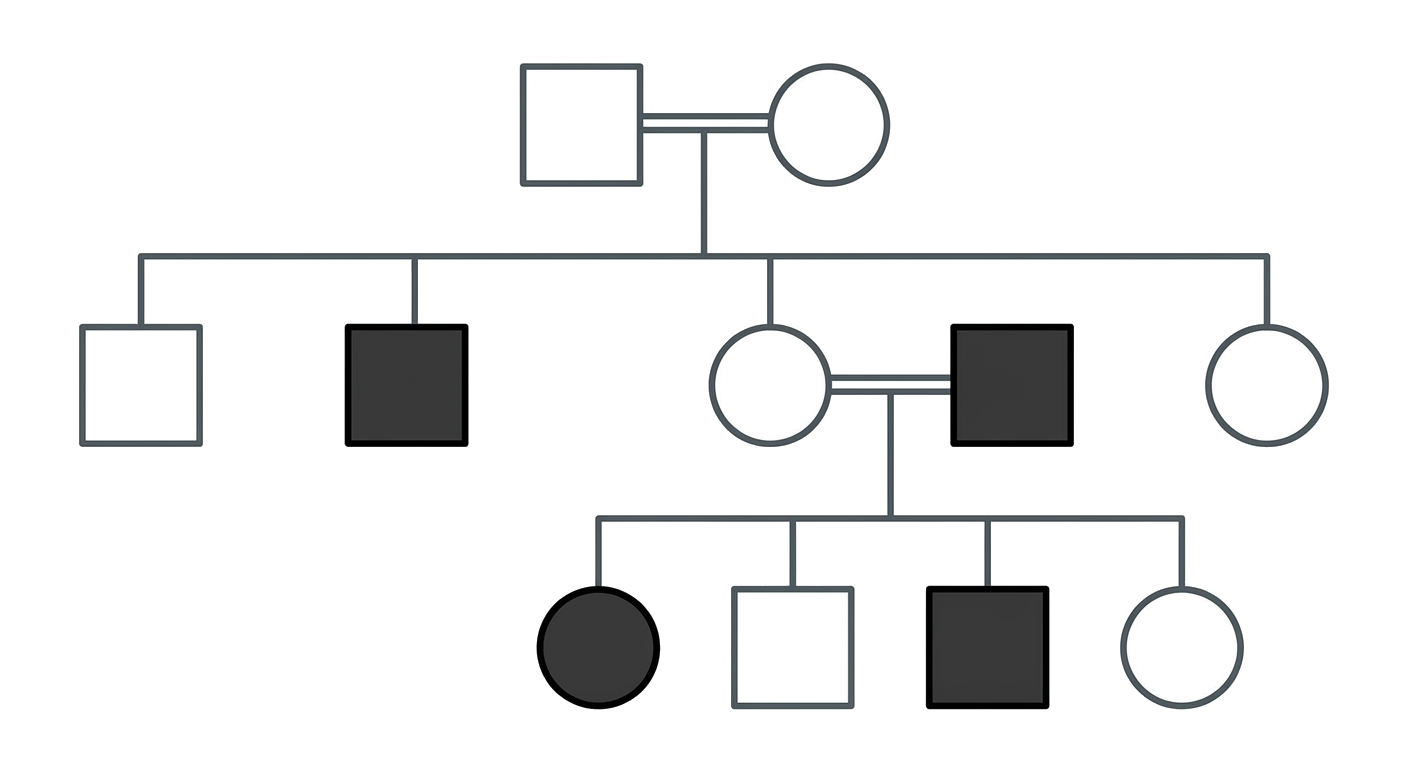
1. In a pedigree chart, what does a square symbol typically represent?
Female
Male
Affected individual
Carrier
2. What does a shaded symbol in a pedigree chart usually indicate?
Unaffected individual
Affected individual
Carrier
Deceased individual
3. A pedigree chart is used to trace the inheritance of a specific through generations of a family.
4. In a pedigree, a horizontal line connecting two individuals indicates a .
5. Vertical lines extending downwards from a marriage line connect to the of that couple.
6. Explain the difference between a square and a circle in a pedigree chart.
7. Why are pedigree charts useful in genetics?
8. A half-shaded symbol in a pedigree chart represents a carrier.
True
False
9. Generations in a pedigree chart are typically indicated by Roman numerals.
True
False
Related Worksheets
The Six Kingdoms of Life
Explore the characteristics and classification of organisms into the six kingdoms: Archaebacteria, Eubacteria, Protista, Fungi, Plantae, and Animalia.
Balance in Nature Worksheet
Explore the intricate balance within ecosystems, including food webs, predator-prey relationships, and the impact of environmental changes on natural balance.
Mitosis Worksheet
Explore the process of mitosis, including its stages and importance in cell division, for Grade 6 science students.
Fungi Fun Facts
Explore the amazing world of fungi with this interactive worksheet for Grade 6 science students.
Animal Cells: Exploring the Building Blocks of Life
This worksheet introduces 6th-grade students to the basic structure and functions of animal cells, including organelles like the nucleus, cytoplasm, and cell membrane.
The Excretory System
Explore the human excretory system with this worksheet for Grade 6 science students. Learn about the organs involved and their functions in waste removal.
Food Chain Fundamentals
Explore the basics of food chains, identifying producers, consumers, and decomposers, and understanding energy flow.
Grade 6 Circulatory System Worksheet
A worksheet for 6th graders to learn about the human circulatory system, including its components and functions.